



Investing in People
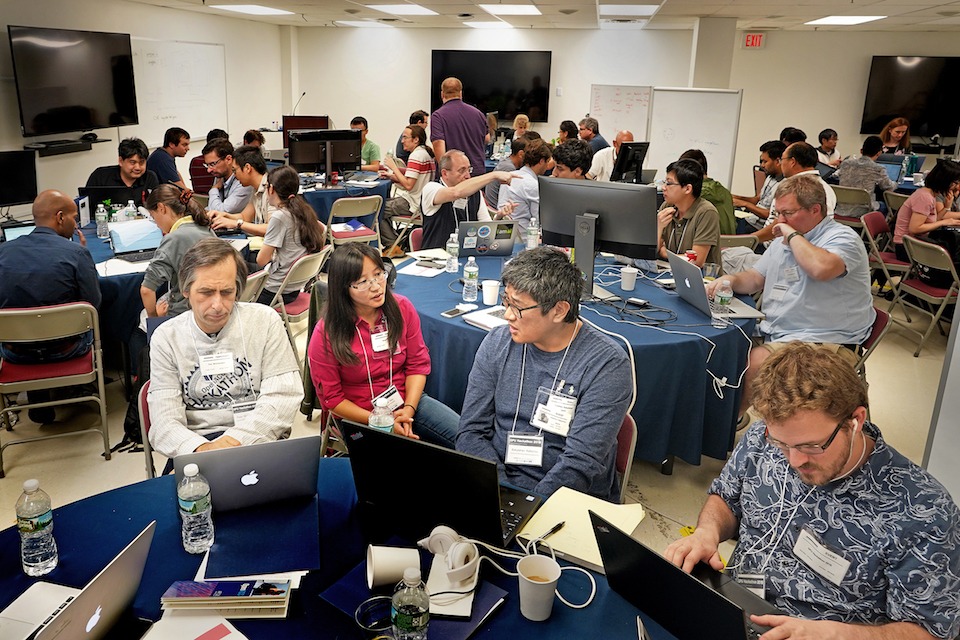 Image courtesy of Brookhaven National Laboratory
Researchers at a GPU Hackathon.
ASCR is committed to developing a skilled workforce in computer science and applied mathematics as well as helping small business and innovators toward the commercialization of products of ASCR sponsored basic research. ASCR manages the Computational Science Graduate Fellowship (CSGF) program and participates in the Office of Science Graduate Student Research (SCGSR) Fellowships and Early Career Research programs. The Lab Embedded Entrepreneurship (LEEP) program is also instrumental to meeting ASCR's goal of investing in people.
The Computational Science Graduate Fellowship (CSGF) program has delivered leaders in computational science both within the Department of Energy national laboratories and across the private sector. The CSGF program has provided over 500 fellowships since the program’s inception in 1991. With increasing demand for these highly skilled scientist and engineers, ASCR continues to partner with the National Nuclear Security Administration to support the CSGF program to increase the availability of a trained workforce for exascale, artificial intelligence and machine learning, and beyond Moore’s Law capabilities such as quantum information sciences.
ASCR also participates in several Office of Science wide activities and initiatives:
- The Office of Science Graduate Student Research (SCGSR) Fellowships enable Ph.D. students at U.S. universities to spend up to 12 months working with scientists at DOE national laboratories on projects that will advance and enhance their doctoral research.
- The Office of Science Early Career Research Program (ECRP) provides an annual funding opportunity for early-career researchers in universities and DOE national laboratories. Established in 2010, this program supports the individual research programs of outstanding early-career scientists and stimulates research careers in the disciplines supported by the Office of Science.
The Lab Embedded Entrepreneurship Program (LEEP) is a two-year fellowship program supported by multiple program offices at the Department of Energy. The mission of LEEP is to provide fellows who have emerging technologies with the support needed to develop and transition their ideas into the market. LEEP taps into the many unique resources, facilities, and personnel at the national labs. LEEP nodes also leverage the vast business and manufacturing acumen present in innovation ecosystems locally, regionally, and nationally. The program seeks to move innovations into deployment at scale far more quickly and efficiently than is typical.
ASCR Funding
- FY2025: Early Career Research Program: Funding Opportunity
- FY2024: FY2024 Reaching a New Energy Sciences Workforce (RENEW): Press Release, Award List, Funding Opportunity
- FY2024: FY2024 Funding for Accelerated, Inclusive Research (FAIR): Press Release, Award List, Funding Opportunity
- FY2024: Early Career Research Program: Press Release, Award List, Funding Opportunity
- FY2023: Advanced Scientific Computing Research – Reaching a New Energy Sciences Workforce (ASCR-RENEW): Press Release, Award List, Funding Opportunity
- FY2023: FY2023 Funding for Accelerated, Inclusive Research (FAIR): Press Release, Award List, Funding Opportunity
- FY2023: Early Career Research Program: Press Release, Award Abstracts, Funding Opportunity
- FY2022: Advanced Scientific Computing Research – Reaching a New Energy Sciences Workforce (ASCR-RENEW): Press Release, Award List, Funding Opportunity
- FY2022: Early Career Research Program: Press Release, Award Abstracts, Funding Opportunity
- FY2021: Early Career Research Program: Press Release, Award Abstracts, Funding Opportunity
- FY2019: Early Career Research Program: Press Release, Award Abstracts, Funding Opportunity, Lab Funding Opportunity
- FY2018: Early Career Research Program: Press Release, Award Abstracts, Funding Announcement, Lab Funding Announcement
Award abstracts and information about awards made prior to FY2018 can be found here.
ASCR Workshops and Reports
- Visualization for Scientific Discovery, Decision-Making, and Communication (March 2023)
- Reimagining Codesign for Advanced Scientific Computing (April 2022)
- Basic Research Needs for Management and Storage of Scientific Data (January 2022)
- Data Reduction for Science (April 2021)
- Randomized Algorithms for Scientific Computing (RASC) (July 2021)
- 5G Enabled Energy Innovation: Advanced Wireless Networks for Science (March 2020)
- AI for Science: Report on the Department of Energy Town Halls on Artificial Intelligence for Science (February 2020)
- From Long-distance Entanglement to Building a Nationwide Quantum Internet: Report of the DOE Quantum Internet Blueprint Workshop (February 2020)
- Data and Models: A Framework for Advancing AI in Science (December 2019)
- Quantum Networks for Open Science (QNOS) Workshop (April 2019)
- Workshop Report on Basic Research Needs for Scientific Machine Learning: Core Technologies for Artificial Intelligence (February 2019)
- ASCR Workshop on In Situ Data Management: Enabling Scientific Discovery from Diverse Data Sources (January 2019)
- Basic Research Needs for Microelectronics (October 2018)
- Storage Systems and Input/Output: Organizing, Storing, and Accessing Data for Scientific Discovery (September 2018)
- Crosscut Report: Exascale Requirements Reviews (January 2018)
- Extreme Heterogeneity 2018: Productive Computational Science in the Era of Extreme Heterogeneity Report for DOE ASCR Basic Research Needs Workshop on Extreme Heterogeneity (January 2018)
- ASCR Report on a Quantum Computing Testbed for Science (December 2017)
- Report of the HPC Correctness Summit (October 2017)
Workshop and reports completed prior to FY2018 can be found here.
Other Notable Reports
- Advanced Research Directions on AI for Science, Energy, and Security: Report on Summer 2022 Workshops (May 2023)
- Quantum Information Science and Technology Workforce Development National Strategic Plan (February 2022)
- Report of the Working Group on Educational Curriculum Needs for Quantum Information Sciences (April 2021)
- Opportunities and Challenges from Artificial Intelligence and Machine Learning for the Advancement of Science, Technology, and the Office of Science Missions (September 2020)
- National Strategic Overview for Quantum Information Science (September 2018)
Investing in People Program Managers:
Marco Fornari
Lab Embedded Entrepreneurship Program
Marco.Fornari@doe.gov
David Rabson
Computational Science Graduate Fellowship
Office of Science Graduate Student Research
David.Rabson@doe.gov
