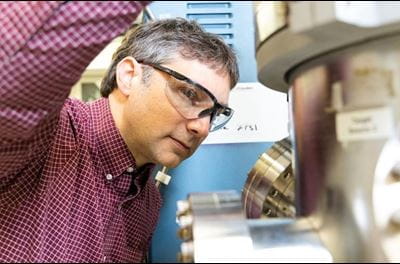
Basic2Breakthrough Stories

A New Approach to Magnetic Coils Advances Stellarators for Fusion Power

An innovative startup licenses Princeton Plasma Physics Laboratory technology to further the comeback of the twisty fusion device.

Read Full Article

Harnessing Machine Learning to Accelerate Battery Design

A collaboration with Toyota Research Institute gives machine learning scientific smarts, revealing why some batteries last longer than others.

Read Full Article

Pfizer Joins Forces with Argonne’s Advanced Photon Source to Aid in the Early Discovery of the First FDA-Approved Oral Antiviral for COVID-19

Research shows Paxlovid™ significantly reduces the risk of hospitalization and death in patients at high risk for progressing to severe COVID-19.

Read Full Article

Serendipitous Discovery Leads to BIG-NET for Capturing Legacy Emissions

A Guanidine solution enables low-temperature carbon capture.

Read Full Article

The Molecular Scissors that Improve Society

CRISPR is a powerful tool that enables scientists to precisely edit DNA, revolutionizing medicine, agriculture, and biotechnology.

Read Full Article

Opening Weather Radar Data to a Wider World of Users

The Python ARM Radar Toolkit progresses from fulfilling basic radar science needs to broader applications in academia, industry, and government.

Read Full Article

Novel Detector Technologies Improve Breast Cancer Imaging and Cancer Treatment

Jefferson Lab technologies for discovery research are transforming into life-saving devices.

Read Full Article

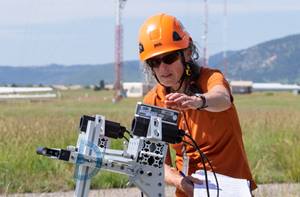
Thermal Tracker Gathers Essential Bird and Bat Data

Computer algorithm combines with optics to help advance offshore wind development.

Read Full Article

Accelerating Industry: Fermilab Makes an Impact with Compact Superconducting Radiofrequency Accelerators

Particle accelerator technologies are spurring new accelerators with applications in sterilizing medical devices, water and environmental cleanup, and materials research.

Read Full Article

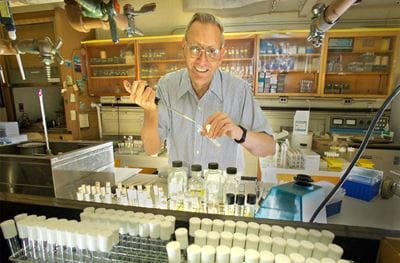
Drop-In Lithium-Ion Battery Technology Mitigates the Risk of Explosion and Fire

Lithium-ion batteries in electric vehicles and consumer electronics are safe, but could be even safer. Drawing on their expertise in materials science, scientists at DOE's Oak Ridge National Laboratory developed the SAFIRE technology, an easy-to-use additive for lithium-ion batteries. In an accident, it changes the batteries’ electrolyte from a liquid to a solid. This shift dramatically reduces the likelihood of a fire or explosion in phones, cars, and many other once-haphazard applications.
Read Full Article

mRNA

The Science Behind the Shot

The fight against COVID-19 drew on decades of foundational biological science research at DOE's Brookhaven National Laboratory. In the 1980s, researchers at the lab were part of a revolution in how scientists use bacteria. As a result, scientists can now engineer tiny organisms to work for us and carry information that changes how other microorganisms behave. The resulting technology paid off in 2020, when Pfizer/BioNTech and Moderna both used this technique to create vaccines for COVID-19.
Read Full Article

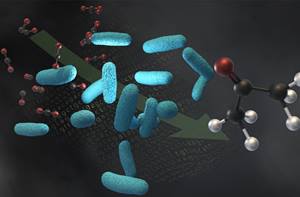
Carbon-Negative Platform Uses Microbes to Turn Waste Gases into Valuable Chemicals

A tiny ally produces big results for decarbonization and clean manufacturing.

Read Full Article

A Dentist’s Journey to Save Your Teeth: From Brazil to Biotech Breakthrough

A Dentist’s Journey to Save Your Teeth: From Brazil to Biotech Breakthrough

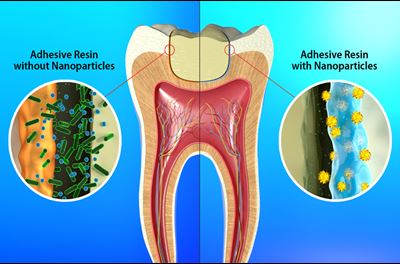
Fewer trips to the dentist, anyone? Nanomaterials may sound like the stuff of science fiction. But researchers at Oklahoma University and DOE’s Oak Ridge National Laboratory are using them to save us time and money on dental work. The scientists fabricated these beyond-microscopic materials that form the root of a new adhesive with antibacterial properties. This adhesive can be used for dental implants and using it would reduce or eliminate the need to replace fillings and crowns. It demonstrates how basic materials science translates into everyday benefits.

Read Full Article