



Megan Rogers
Building Community Through the SULI Experience
A summer internship revealed that scientific discovery is as much about people as it is about research.When Megan Rogers signed up for the Science Undergraduate Laboratory Internships (SULI) program, sponsored by the Department of Energy’s Workforce Development for Teachers and Scientists (WDTS) program, she was surprised with a vibrant community of peers, mentors, and friends. What began as a serious career step quickly became a summer defined by collaboration, connection, and discovery both inside and outside the lab.
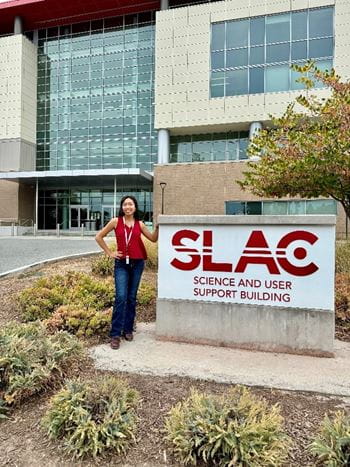
“I don’t think there was a time where I ever felt alone in the experience of going through this internship,” said Rogers. “Despite all of us interns having vastly different projects, we all were a community coming together. Overall, it was a very passionate and collaborative environment, and many people were there to help me along the way.”
After expressing her desire to look for different opportunities, Rogers’s counselor at Cañada College in California recommended she apply for SULI. She learned that SLAC National Accelerator Laboratory was located nearby and was excited to be accepted into their program.
If interested in an internship, “I would say just go for it,” she said. “Please apply because it is worth it. I think all the connections that you make and all the skills that you learn will be lifelong and will help you in the future.”
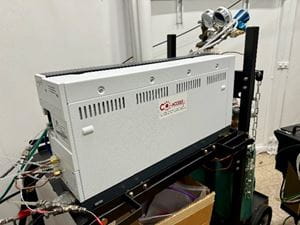
At SLAC, Rogers contributed to the Accelerate Innovations Team in the Stanford Synchrotron Radiation Lightsource (SSRL) by creating gas chromatograph calibration curves to measure the inputs and outputs of the reverse water-gas shift reaction, enabling correlations between product formation and catalyst structure. She also worked at SSRL, with the Co-Access group to determine how to optimize catalyst performance.
Participating in the SULI program gave Rogers the opportunity to see what other jobs were available at SLAC. While strengthening her computer software skills, as well as working hands-on with the actual equipment, she was able to build up her qualifications and secure a follow-up internship with SLAC.
Rogers gained hands-on experience managing compressed gas systems which included installing regulators, leak checking, and safety protocols. As a result, these skills have proven beneficial to her chemical engineering lab courses.
 “I think it helped me gain a lot of confidence in those skills, and I’m so grateful to this program because I don’t think I would have had any of these experiences if I didn’t join SULI,” Rogers stated.
Rogers recently transferred to University of California, Berkeley where she is obtaining her bachelor’s degree in chemical engineering. She credits her SULI internship in helping her decide to pursue a PhD, something she wasn’t entirely sure about. However, being around so many passionate people helped her visualize herself in those roles.
“I want to go into research, so this whole internship experience really solidified that understanding,” she shared. “The internship really helped me see what options there were because there are other different types of projects that chemical engineering majors could work on.”
While she admits she was unaware of the WDTS’s Community College Internship program until after she was accepted into SULI, she highly recommends either program to those interested in furthering their science, technology, engineering, and mathematics careers.
“I can’t imagine how my life would be without it now because not only did I get really hands-on experience, but I met so many people that I know I will have connections with for the rest of my life,” Rogers explained. “I honestly believe that every undergraduate student should go through a program like this where they have a mentor guiding them through research that they may potentially go into in the future. It’s very useful.”
