



Astrid Reyes-Torres
Algae-rithms of Change
Turning the destruction from hurricanes into an inspirational way to give back to her community
.jpeg?h=533&w=400&hash=BF67B8015D84EA7DC4B3DFE52164C6EB "Astrid Reyes-Torres begins her experiment with the plastic-degrading enzyme PETase in Building 743 at the National Synchrotron Light Source II at Brookhaven National Laboratory.") While many 21-year-olds toast to their birthday with friends, Astrid Reyes-Torres spent hers surrounded by algae cultures inside the Brookhaven National Laboratory (BNL) in New York.
While many 21-year-olds toast to their birthday with friends, Astrid Reyes-Torres spent hers surrounded by algae cultures inside the Brookhaven National Laboratory (BNL) in New York.
“It was a small birthday celebration, but it reminded me of the importance and excitement of the work we were doing,” said Reyes-Torres. “I was very happy that day because not only was it my birthday, but I had important work to do.”
Reyes-Torres is a biology major at the University of Puerto Rico in Cayey and joined BNL during the summer of 2024 through the Science Undergraduate Laboratory Internships program offered under the Department of Energy’s Workforce Development for Teachers and Scientists program.
Born in Puerto Rico, Reyes-Torres witnessed first-hand the devastation caused by hurricanes, inspiring her to refine methods to help prevent the increase of plastics found in oceans.
“I work specifically on degrading a piece of plastic with algae,” Reyes-Torres explained. “I would culture the algae on a piece of plastic so the algae can basically eat that plastic. We did experiments with plastic enzymes, seeing the differences between the degradation of plastics alone, enzymes alone, or the plastic, enzymes and algae together.”
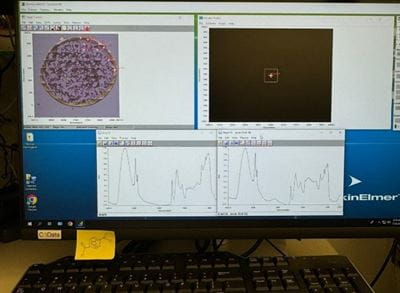
Her team used infrared spectroscopy to measure the differences between each sample, including changes in chemical structure and hardness. And while she may have celebrated her birthday amongst growing algae samples, she also fostered relationships with fellow researchers and mentors who helped her pursue new opportunities.
“I made many friends, connected with scientists, and continued to grow in my career,” Reyes-Torres shared. “During SULI I participated in different competitions, such as the Ignite Off! competition. These helped me improve my scientific speaking skills and prepare for my poster presentations.”
At the conclusion of the internship, Reyes-Torres’ mentor Lisa Miller, a senior biophysical chemist at BNL, encouraged Reyes-Torres to present her research project at the National Synchrotron Light Source II Symposium. Reyes-Torres’ oral and poster session was titled, “Characterization of Poly(ethylene terephthalate) Biodegradation Products by Microalgae Using Synchrotron Infrared Microspectroscopy”.
“Lisa was a very attentive mentor who gave me incredible support and guidance,” Reyes-Torres shared. “She was the one who encouraged and authorized me to present our research at conferences.”
Reyes-Torres also received encouragement from Enrique Rodriguez, her mentor at the University of Puerto Rico in Cayey, who aided her in applying to the DOE Mini-Semester program. This undergraduate opportunity allows STEM students to learn, discover and participate in science and technology exploration with experienced scientists and staff at BNL.
“Upon Rodriguez’s recommendation, I applied immediately, recognizing the value of these experience sin strengthening my academic and professional development,” Reyes-Torres said. “This opportunity not only expanded my understanding of careers in science and research at the Department of Energy but also reinforced the importance of having a strong support network like the one I have found at Cayey.”
 Once arriving at BNL, Reyes-Torres was initially intimidated by the large size of the laboratory but was thankful to the staff who helped guide her around. By the time she participated in the SULI program, the BNL campus felt more familiar.
“It was a very successful summer,” Reyes-Torres exclaimed. “We went to New York on the weekends to different museums and eat ice cream. We really enjoyed the summer and being able to balance the lab work.”
She advises those interested in WDTS programs not to be afraid of stepping outside their comfort zone. She believes her hard work and determination has helped her become more connected.
“Just give it a chance and not be scared about the opportunity,” she said. “Just look at every opportunity as a way to further your personal and professional growth.”
For the summer of 2025, Reyes-Torres received an internship at the University of Wisconsin. She plans to graduate with her bachelor’s in biology in 2026.
Her 21st birthday may have been a quiet evening observing algae, but with lab research under her belt, a better understanding of presenting in front of peers, and overall more confidence in her abilities, her future is poised to bloom with endless possibilities.
“This experience was really gratifying, and everyone should have this opportunity!” she said.
