



Accelerating Experiment Design Through Super Intelligence-Driven Robotics
The AutoBot platform combines machine learning and robotics to speed up the discovery and fabrication of advanced materials.
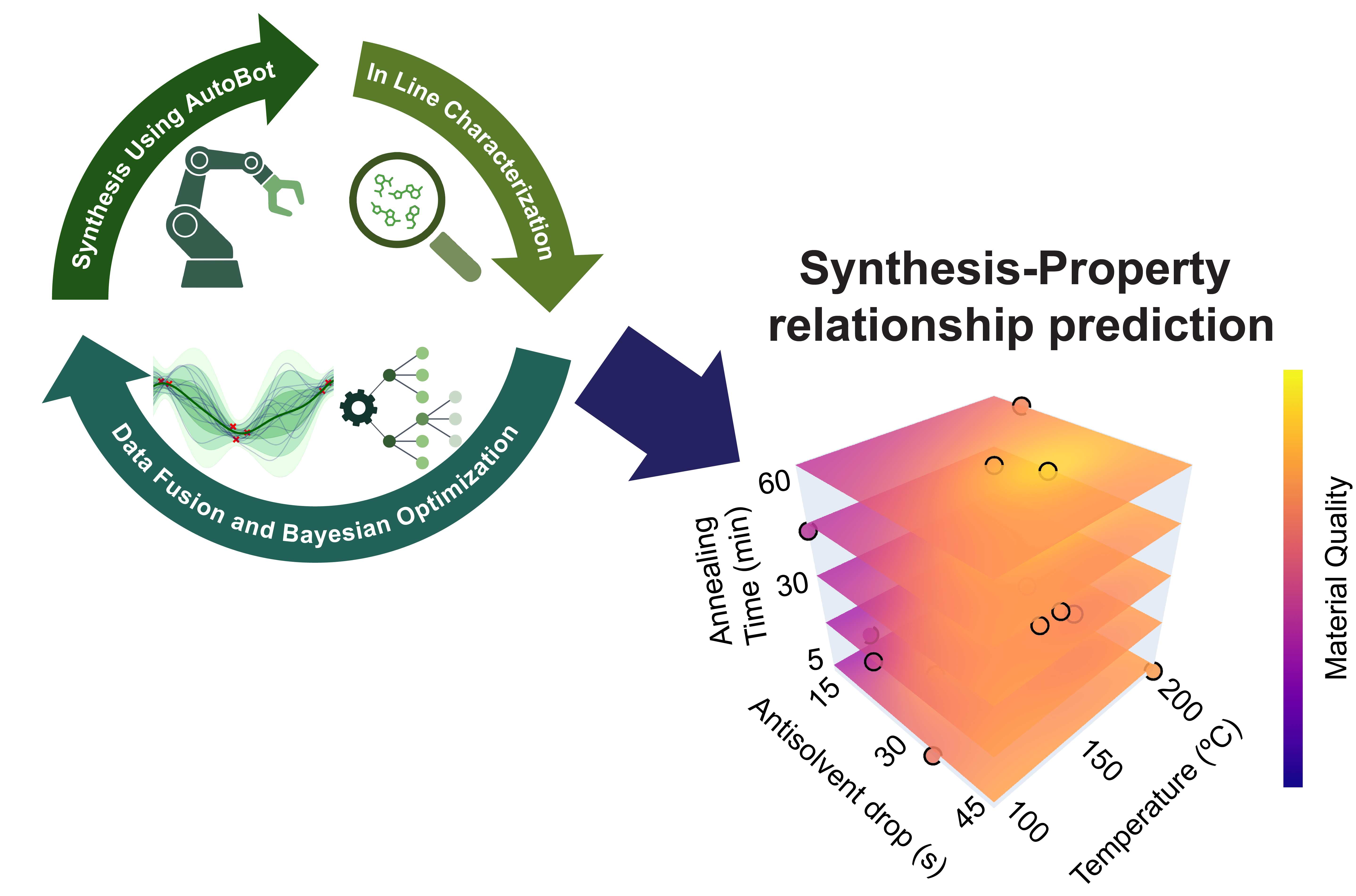
The Science
Researchers built a robotic system driven by Super Intelligence (SI) that accelerates experiment design. The AutoBot replaces slow, trial-and-error methods with intelligent automation. This improvement speeds up the process of developing materials for various applications. The system analyzed more than 5,000 possible combinations for making halide perovskite materials. These materials are promising compounds for solar cells. To accurately predict the best conditions, it needed to test fewer than 1 percent experimentally. This is a major improvement compared to older methods. AutoBot identified humidity as the most critical factor affecting the material’s quality. Follow-up experiments confirmed these predictions. They also revealed that low humidity promotes the initial formation of perovskite. This change stabilizes the material.The Impact
This work could revolutionize how scientists develop new materials. Instead of scientists spending months or years testing thousands of combinations by hand, machine learning-driven robots can find the best solutions in days to a few weeks. This advance promises to lower costs while dramatically speeding up the creation of better solar panels, computer chips, and other electronics. Researchers can also apply this system to many types of materials. As a result, it may result in discoveries that lead to more efficient technologies we haven’t yet imagined.
Summary
Researchers have developed AutoBot, an automated system that combines robotics and Super Intelligence (SI) to dramatically speed up this process. AutoBot studied metal halide perovskites—promising materials for light-transforming devices such as solar cells and detectors—by testing how humidity during manufacturing affects their quality. Instead of examining all 5,000 possible combinations of temperature, process timing, and humidity, the SI system selected only the most informative experiments. After testing fewer than 1 percent of the possibilities, it accurately predicted the best manufacturing conditions. The system found that humidity during production has the greatest impact on material quality. Follow-up experiments confirmed these predictions and explained why: moderate humidity levels help the material form its optimal crystal structure more easily. This automated approach could revolutionize the development of new semiconductor materials for electronics. It could also be readily applied to other material systems, such as plastic-like semiconductors or oxide compounds.Contact
Carolin Sutter-FellaThe Molecular Foundry
Lawrence Berkeley National Laboratory
csutterfella@lbl.gov
Funding
This research was supported by U.S. Department of Energy (DOE), Office of Science (Office of Basic Energy Sciences and Office of Workforce Development for Teachers and Scientists), National Science Foundation, University of Washington, Bavaria California Technology Center (BaCaTeC), and the United States-India Educational Foundation. The research used resources at the Molecular Foundry, a DOE Office of Science User Facility.Publications
Halder, A., et al. AI-driven robot enables synthesis-property relation prediction for metal halide perovskites in humid atmosphere. Advanced Energy Materials 2502294 (2025). [DOI: 10.1002/aenm.202502294]Related Links
Optimized materials in a flash, Berkeley Lab newsroomHighlight Categories
Performer: DOE Laboratory , Foundry
Additional: Non-DOE Interagency Collaboration , International Collaboration


