




A New Approach to Magnetic Coils Advances Stellarators for Fusion Power
An innovative startup licenses Princeton Plasma Physics Laboratory technology to further the comeback of the twisty fusion device.
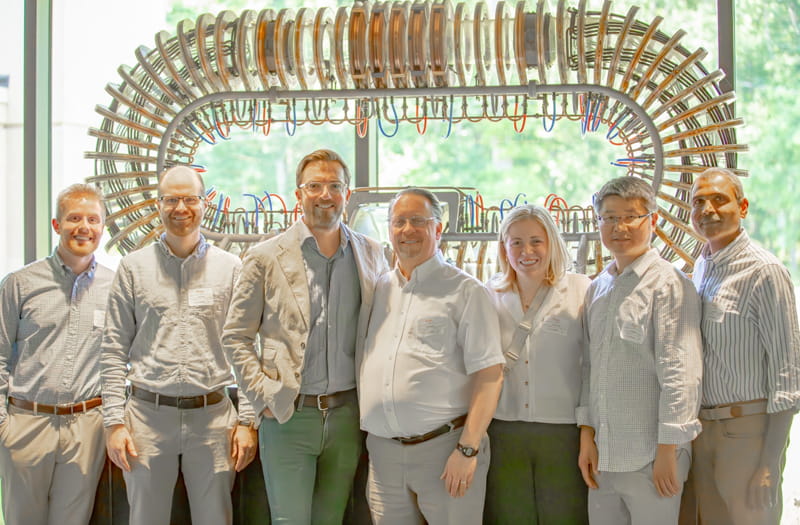
Physicist David Gates aims to bring to fruition the dream of a visionary Princeton University astrophysicist named Lyman Spitzer. Some 70 years ago, Spitzer invented a magnetic device called a stellarator and launched a laboratory in a rabbit hutch to develop an energy source that would reproduce the same fusion process that drives the sun and stars. His goal: to build a series of stellarator test devices to study how such a novel power plant might work. But stellarator development hit serious snags and took a back seat to a Soviet magnetic invention called a tokamak in the late 1960s.
Now Gates, chief technology officer of the startup company Thea Energy (formerly Princeton Stellarators) and former head of stellarator development at the Department of Energy’s (DOE) Princeton Plasma Physics Laboratory (PPPL), says his company is on the way to realizing the Spitzer’s dream. The startup is also among the eight companies to receive funding from the DOE’s $46 million Milestone-Based Fusion Development Program.
Both stellarators and tokamaks are designed to mimic the stars by squeezing together light elements in the form of plasma — the hot, charged state of matter composed of free electrons and atomic nuclei — to release virtually limitless, safe and clean energy. Both technologies are on the road to producing more energy than they need to create that energy, an essential feat that no magnetic device has so far achieved.
However, donut-shaped tokamaks have confined plasma more tightly than stellarators, producing more energy and dominating experiments since the late 1960s. That drawback limited the development of stellarators, which can run steadily without risking the damaging disruptions that tokamaks face. “The only reason the stellarator didn’t take over the world in the 1950s was because we hadn’t solved the confinement problem,” Gates said.
Moreover, “the best performing stellarator coils since the 1980s have been extremely complicated,” said Charles Swanson, a former PPPL physicist who manages the design of Thea Energy’s devices. “An engineering drawing couldn’t capture all the twisted shapes,” he said. “They had to be represented digitally and manufactured with very advanced techniques.”
Scientists have now modified the magnetic field the coils create into a special arrangement called “quasi-symmetry.” Thermal confinement of the plasma has improved substantially and is now on par with that of tokamak devices. Scientists have demonstrated this improved confinement at the Wendelstein 7-X in Germany, today’s largest and most advanced stellarator.
But stellarator magnets have remained impractical, with highly precise spaghetti-like coils wrapping around the plasma. Such coils are by far the costliest and most difficult stellarator components to produce.
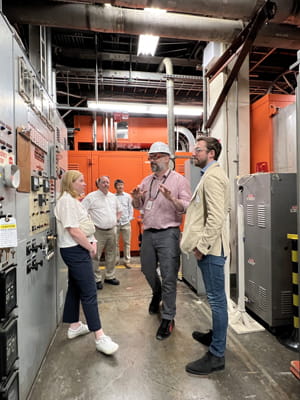
“We’ve reinvented the stellarator with no more wiggly coils,” Gates said of the radical breakthrough the startup is pursuing. “The basic idea is that we can replace twisting coils with flat coils with varied current in them. So, we’ve taken the complexity out of the coils and put it into the control system.”
One of the PPPL’s core strengths is computational science. Researchers at the lab are using powerful supercomputers to fine-tune and test computer codes while also virtually exploring the complexities of plasma. Future collaborations between Thea Energy and PPPL will investigate the use of machine learning and artificial intelligence algorithms for real-time control of three-dimensional stellarator magnetic configurations. The technique will use Thea Energy's proprietary flat coil array technology.
The concept draws on technologies licensed from PPPL, where Gates had led the notion of replacing complex electromagnets with far simpler permanent ones. “It’s inspired by the permanent magnet idea that we were working on,” he said.
The laboratory was fully supportive. “We were happy to cooperate with the new company as we believe public-private partnerships are key to developing fusion, a clean energy source for the world,” said Steve Cowley, director of PPPL, whose primary project is the National Spherical Torus Experiment-Upgrade (NSTX-U). The compact tokamak promises a route to a lower cost fusion reactor. “There can never be too many entrants in the fusion field.”
The startup now aims to put stellarator-generated electricity on the grid in the mid-2030s. “For fusion energy to become commercialized to make carbon-free energy, you need to have power plants that run in steady state as stellarators do,” said Brian Berzin, CEO of Thea Energy.
“But there won’t be a winner take all,” he said. “If you turned out a 200 megawatt fusion plant every day for 40 years, it still wouldn’t fully offset fossil fuel power generation. It’s that big of a market and that big of an issue to decarbonize the grid.” All options are therefore open for fusion technology.
This article was created in partnership with Princeton Plasma Physics Laboratory, learn more about their work.
Read more stories in the Basic2Breakthrough series.
