




Harnessing Machine Learning to Accelerate Battery Design
A collaboration with Toyota Research Institute gives machine learning scientific smarts, revealing why some batteries last longer than others.
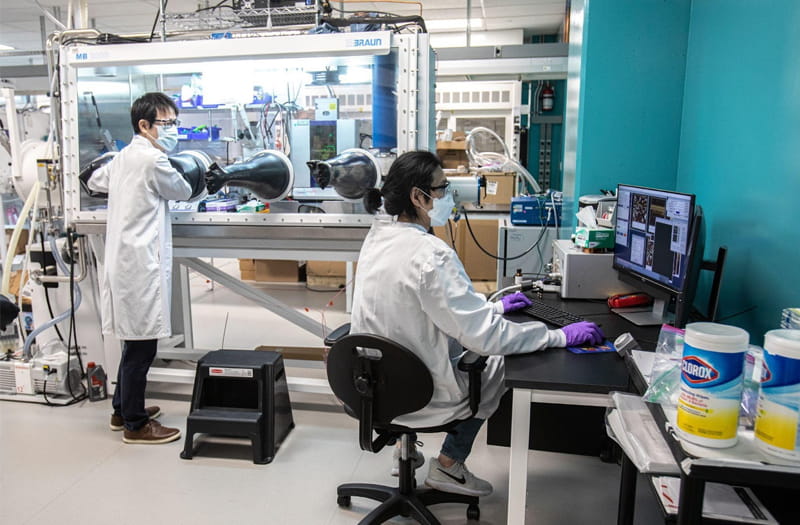
Expanding the world’s electric vehicle fleet is a crucial part of the overall strategy for fighting climate change. To do that, we’ll need smaller, lighter, safer, and more powerful batteries that can be charged in about the same amount of time it takes to fill a gas tank. But batteries involve complex interactions of chemicals and materials that scientists have been studying since the 1800s. Even today, scientists face the challenge of stresses from fast charging and the resulting damage to lithium-ion batteries. Testing various battery configurations to see how they hold up to fast charging has been too slow to meet today’s challenges.
Scientists at SLAC, Stanford University, Toyota Research Institute, and the Massachusetts Institute of Technology have found a solution. They’ve been using a branch of artificial intelligence (AI) called scientific machine learning to speed up battery testing and quickly winnow down many possible charging methods to find the ones that work best. In the most recent advance, they gave machine learning scientific smarts by teaching it how to learn the physics of a new type of battery aging mechanism. This gave them a “movie” of how lithium moves around inside the battery, painting a very different picture than previously held.
Combining these machine learning techniques could slash the time needed to bring a new battery technology from lab bench to consumer by as much as two-thirds, said William Chueh, an associate professor at Stanford and director of the new SLAC-Stanford Battery Center. The center combines the resources and expertise of the national lab, Stanford University, and Silicon Valley to accelerate the deployment of batteries and other energy storage solutions.
Research and development at the center will range from understanding chemical reactions that store energy in electrodes to designing battery materials at the nanoscale. The center will also produce and test devices, improve manufacturing processes, and find ways to scale up those processes so they can become part of everyday life. Machine learning, Chueh said, will be an important tool for doing this work.
Shijing Sun, a senior research scientist with Toyota Research Institute who’s been collaborating with Chueh, said, “We’re looking for ways to apply machine learning to multiple stages of battery life, from testing during battery fabrication to giving retired EV batteries a second life by using them to store energy on the electric grid. I’m very excited to work with SLAC and Stanford and see what we find.”
“The way a battery is used, whether for a cell phone or an EV, affects how it degrades. We use advanced machine learning to combine what we know about a specific application with data that give us a fundamental understanding of how batteries degrade,” said another collaborator, Stanford Assistant Professor Simona Omori.
This new machine learning and AI approach to accelerating the battery development cycle is having a big impact on industry, Chueh said. Students who led this work at SLAC and Stanford, as well as a number of Silicon Valley startups, are implementing AI in unprecedented ways in industry to bring disruptive battery technologies to the market.
For instance, chemical companies are harnessing AI inspired by the SLAC work to dramatically speed the evaluation of new battery materials that are cheaper, more efficient, and more abundant. Automakers use AI to predict how electric vehicle batteries age under real-world driving conditions.
Xiao Cui, a PhD student in Chueh’s group, has been investigating how a battery’s first activation cycle changes its electrodes in a way that affects future performance. Before machine learning, she said, analyzing the many cycling parameters that could affect battery life would have taken years; now it takes months. Machine learning also turns up new research ideas that more traditional methods would not generate.
“It definitely saves a lot of resources and time,” Cui said. “And it’s not limited to battery research. It demonstrates a framework you can use to optimize and study other complex systems.”
This article was created in partnership with SLAC National Accelerator Laboratory, learn more about their work.
Read more stories in the Basic2Breakthrough series.
