




Pfizer Joins Forces with Argonne’s Advanced Photon Source to Aid in the Early Discovery of the First FDA-Approved Oral Antiviral for COVID-19
Research shows Paxlovid™ significantly reduces the risk of hospitalization and death in patients at high risk for progressing to severe COVID-19.
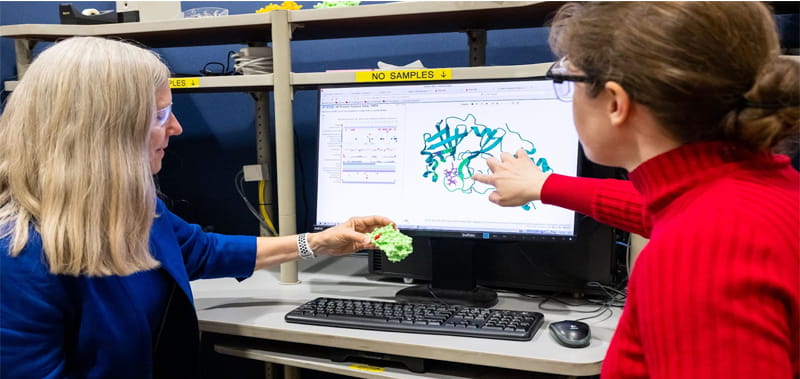
It’s not often that basic research leads quickly to a game-changing, potentially life-saving application. Yet that’s exactly what happened with Paxlovid, pharmaceutical company Pfizer’s oral antiviral to treat COVID-19 in patients at high risk of progression to severe disease.
Paxlovid consists of two tablets, nirmatrelvir and ritonavir. Scientists discovered nirmatrelvir, the active inhibitor in Paxlovid, over several months in early 2020 while the pandemic still raged. To better understand how nirmatrelvir might interact with the virus that causes COVID-19, Pfizer analyzed crystal structure data generated using the Advanced Photon Source (APS). The APS is a Department of Energy (DOE) Office of Science user facility at DOE’s Argonne National Laboratory. Nirmatrelvir immediately showed promise and ultimately advanced in Pfizer laboratories and clinical trials. Pfizer received an emergency use authorization from the Food and Drug Administration (FDA) in December 2021. In May 2023, Pfizer received full FDA approval for Paxlovid use in high-risk adults.
Since December 2021, more than 11.6 million Paxlovid treatment courses have been prescribed in the United States. The Centers for Disease Control and Prevention reports that Paxlovid has been associated with decreased hospitalizations among high-risk adults with the disease.
Paxlovid’s early discovery was enabled, in part, by the drug discovery program of the Industrial Macromolecular Crystallography Association Collaborative Access Team (IMCA-CAT) beamline at the APS. IMCA-CAT is operated by the Hauptman-Woodward Medical Research Institute (HWI) on behalf of a collaboration of pharmaceutical companies, including Pfizer. Researchers took advantage of IMCA-CAT to progress rapidly on what became Paxlovid. Pfizer went on to develop Paxlovid in record time, according to Lisa Keefe, executive director of IMCA-CAT and vice president for advancing therapeutics and principal scientist at HWI.
“IMCA-CAT can deliver quality results in a much timelier manner than the home laboratories of its member companies,” Keefe said. “Paxlovid is an important illustration of the value of the DOE national laboratories to U.S. industries, which has an enormously beneficial impact on society. It’s especially inspiring when the results have a global benefit, as we’ve seen with this treatment for COVID-19.”
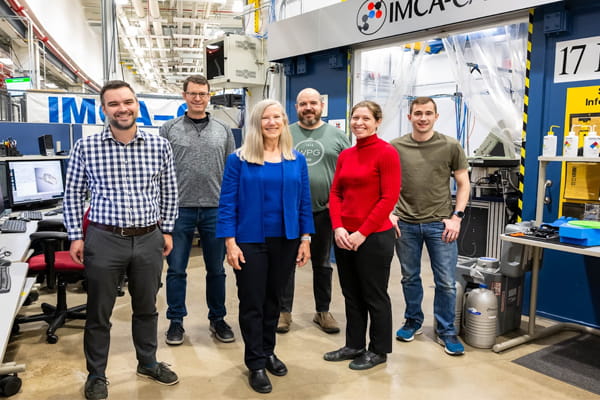
IMCA-CAT enables a type of science called macromolecular crystallography. Scientists use the X-ray beams of the APS – about a billion times brighter than those used by dentists – to illuminate the structures of proteins that make up viruses. Researchers then use this information to see how potential drug compounds interact with those proteins. IMCA-CAT enables rapid analysis of many potential drug candidates, speeding up the drug discovery process.
The structural biology efforts that resulted in Paxlovid were led by Samantha Greasley, a protein crystallographer with Pfizer.
“The COVID-19 pandemic has underscored the importance of collaboration across the scientific community to advance important research – urgently, safely, and with the highest quality – for patients in need,” Greasley said. “Our partnership with IMCA-CAT enabled the rapid production of high-resolution crystal structures, which allowed Pfizer to better understand how compounds, including nirmatrelvir, were interacting with the virus. We look forward to our continued partnership to progress scientific discovery across many disease areas.”
The DOE national laboratories and user facilities have been at the forefront of the fight against COVID-19 since the beginning. The discovery of Paxlovid is only one of the many examples of scientists conducting life-changing research at user facilities.
“It’s immensely gratifying for the APS facility to have played a part in the discovery of this life-saving treatment,” said Laurent Chapon, associate laboratory director for photon sciences at Argonne and director of the APS. “Paxlovid is a testament to the impact of the DOE national laboratories and their scientific user facilities, working cooperatively with the pharmaceutical industry to solve some of the most pressing challenges that society faces.”
This article was created in partnership with Argonne National Laboratory, learn more about their work.
Read more stories in the Basic2Breakthrough series.
