




Serendipitous Discovery Leads to BIG-NET for Capturing Legacy Emissions
A Guanidine solution enables low-temperature carbon capture.
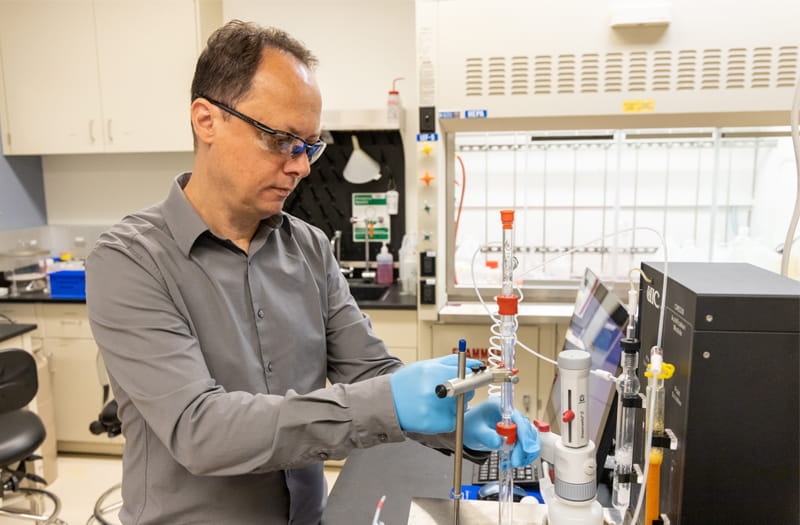
In 2016, Oak Ridge National Laboratory (ORNL) organic chemist Radu Custelcean and his team were experimenting with a method to remove environmental contaminants such as sulfate, chromate, or selenate from water, when they made an unexpected discovery. The chemical solution in their experiments was removing another important molecule — not from water, but from air.
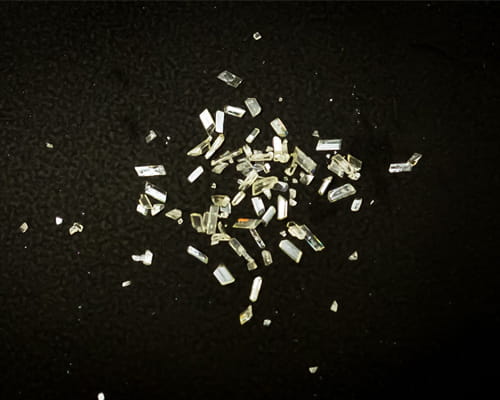
“When we left an aqueous solution of guanidine open to air, beautiful prism-like crystals started to form,” he said. “After analyzing their structure by X-ray diffraction, we were surprised to find the crystals contained carbonate, which forms when carbon dioxide from air reacts with water.”
Developing this breakthrough technology required a foundational knowledge of materials and chemical processes cultivated over decades of basic science research. Over the past several years, an ORNL team of chemists and engineers has worked to better understand and refine the chemical processes at play, ultimately resulting in a commercially ready process that enables low-temperature and low-cost direct air capture. This is a critical technology to limit global warming by removing greenhouse gases from the atmosphere.
“Direct air capture allows us to collect legacy emissions,” said Custelcean. “Our technology is one of the few approaches that can do that. It offers a new, energy efficient approach to removing CO2 directly from air.”
Holocene, a Knoxville, Tennessee-based startup founded by Anca Timofte, has licensed the ORNL chemistry. Timofte, a Breakthrough Energy fellow, also is participating in ORNL’s Innovation Crossroads, a Department of Energy (DOE) Lab-Embedded Entrepreneurship Program.
“ORNL’s chemistry combines the best features of existing approaches to direct air capture to create a water-based, low-temperature process,” Timofte said.
In direct air capture, a large fan pulls air through a contacting chamber where the air interacts with chemical compounds that filter and capture carbon dioxide. The CO2 can then be released from the capture material and stored deep underground.
The ORNL process, which requires minimal energy and chemical input, uses an aqueous solution containing receptors called Bis-iminoguanidines, or BIGs, to absorb carbon dioxide. As this happens, BIGs turn into insoluble crystalline salts, which can easily be separated from the liquid solution by simple filtration. Mild heating of the crystals then releases the CO2, which is collected and sent out for permanent storage or for conversion into useful products.
“The synthesis of the guanidines is quite simple, so they are relatively cheap to make, require readily available precursors, and are easy to scale up,” Custelcean said.
The BIGs discovery propelled his research in a new direction.
“Doing basic research under DOE’s [Office of Science] Basic Energy Sciences program, I have the flexibility to change direction if I find something interesting,” Custelcean said. “The basic research allows us to better understand all the elementary reactions and processes involved.”
After the initial discovery, the team studied the material’s crystalline structure and properties with the unique neutron scattering capabilities at ORNL’s Spallation Neutron Source, a DOE Office of Science user facility. By analyzing carbonate binding in the crystals, they gained a better understanding of the molecular mechanism of carbon dioxide capture and release.
“I have focused on the science of developing and optimizing materials for carbon capture, but you need many other people with different backgrounds to turn the work into a real-world technology,” Custelcean said. “Through licensing, we get to see with the help of our industrial partners a progression from basic science to a mature technology that may be deployed in the real world and eventually make a positive impact on the climate.”
Next up, Holocene and ORNL will conduct bench-scale testing funded by DOE’s Office of Fossil Energy and Carbon Management to use ORNL’s chemistry to further develop and deploy direct air capture at a commercial scale.
This article was created in partnership with Oak Ridge National Laboratory, learn more about their work.
Read more stories in the Basic2Breakthrough series.
