




Opening Weather Radar Data to a Wider World of Users
The Python ARM Radar Toolkit progresses from fulfilling basic radar science needs to broader applications in academia, industry, and government.
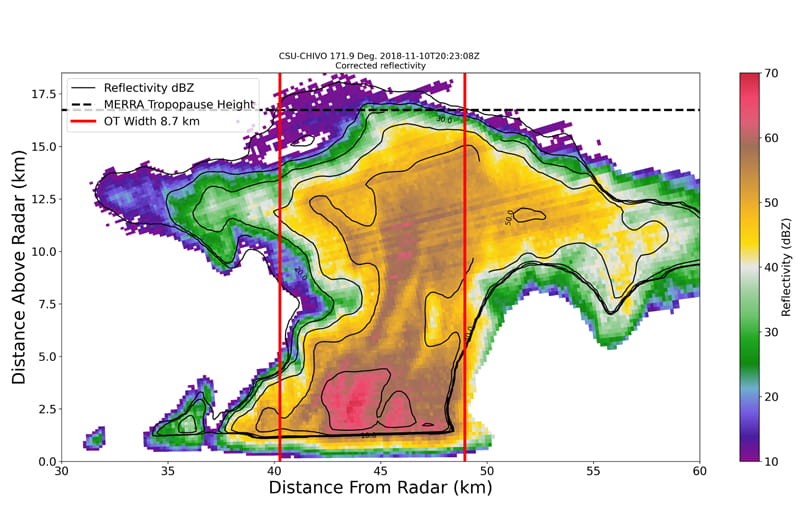
A single weather radar can produce hundreds of gigabytes of data per day, the byte-size equivalent of a full-length feature film every minute. When working with geospatially complex, four-dimensional radar data, researchers need software that can help them extract scientifically meaningful information from the measurements.
In 2012, Department of Energy (DOE) scientists developed an open-source package to read, visualize, correct, and analyze data from the new generation of scanning cloud and precipitation radars operated by Atmospheric Radiation Measurement (ARM), a DOE user facility. Since becoming publicly available a decade ago, the Python ARM Radar Toolkit (Py-ART) has built up a worldwide community of thousands of users working with radar data from ARM and other organizations for a variety of applications.
To retrieve images of objects in the atmosphere, such as clouds and precipitation, radars send out pulses of electromagnetic energy. Those pulses reflect off whatever they encounter, sending back shaped reflections of energy that experts interpret for information about cloud and precipitation particles, including their size, type, location, and speed. Those same reflections can reveal information on insects, birds, and buildings, making radars useful for more than weather.
“Radar allows us to peer inside of clouds,” says Py-ART Science Lead Scott Collis of Argonne National Laboratory. “By sending pulses of microwave energy into clouds and thunderstorms, we can see the very physics at play, which we need to understand to model our climate. No other instrument can penetrate a cloud in the same way.”
To help users more easily work with radar data, the Py-ART package is organized by subpackages oriented to different functions: storage, formatting, display, correction, gridding and mapping data, and calculation of geophysical variables such as rainfall rate.
“The extensive library of functions within Py-ART has helped me focus on research activities instead of writing long programs,” says Siddhant Gupta, a Brookhaven National Laboratory research associate who uses data gridded in Py-ART to study the life cycle of deep convective clouds.
Behind it all is Python, a popular programming language used worldwide. Py-ART is underpinned by a vibrant ecosystem of community-driven software libraries.
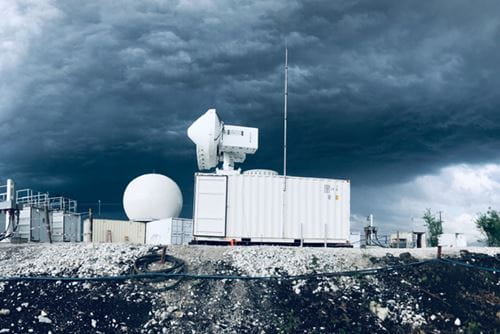
“Almost every nation on Earth has a weather radar network. It’s important for life and property, for weather warnings, and for science,” says Collis. “Py-ART gives you a workflow to take that really complex data set and make it easier to improve our weather and climate models.”
To tease out the kind of information needed to improve model simulations, Py-ART employs sophisticated algorithms developed by radar experts around the world.
Py-ART is hosted on GitHub, where anyone can use, update, and share the software, including its source code. A control system tracks source code changes, with a suite of tests to ensure that none of the changes break or degrade Py-ART’s functionality.
Laura Tomkins, a doctoral candidate at North Carolina State University, recently contributed a function to help distinguish heavy snow from mixed precipitation in radar imagery.
“I thought it would be a great place to be able to share my code and share my workflow with others so that other people could use it too,” says Tomkins.
Documentation includes user and developer reference manuals, as well as prewritten computational scripts to show Py-ART’s expanding community how the software can be used.
“Py-ART has democratized access to radar data,” says Collis. “Everyone can interact with this rich data set, from high school students to machine learning experts and everyone in between.”
In 2021, the New York Times used Py-ART to visualize the life cycles of storm clouds generated by massive wildfires. In a growing universe of applications, scientists have also used the software to map mayfly populations in Canada, survey waterfowl in flight over Australia, and even identify likely meteorite fall zones in the continental United States.
Other Py-ART beneficiaries include industry (IBM is one example); academia (Australia’s University of Queensland, for instance); and U.S. government agencies such as NASA and the National Oceanic and Atmospheric Administration.
Meanwhile, ARM has incorporated Py-ART code into its architecture of engineering and operations. The software also informs many of the ARM data products that retrieve information about the atmosphere.
This article was created in partnership with Atmospheric Radiation Measurement, learn more about their work.
Read more stories in the Basic2Breakthrough series.
