




Novel Detector Technologies Improve Breast Cancer Imaging and Cancer Treatment
Jefferson Lab technologies for discovery research are transforming into life-saving devices.

Breast cancer is the second most common cancer among women in the United States today. Now, advanced technologies originally developed at the Thomas Jefferson National Accelerator Facility (Jefferson Lab) for studying the tiniest particles inside matter have been adapted to aid doctors in diagnosis and treatment of breast cancer patients.
Regular screening with mammography is the gold standard for catching breast cancer early. However, half of all women who follow standard screening protocol for a decade will receive a false positive result. This is particularly true for women who have dense breast tissue. Women with dense breast tissue also face a higher risk of developing breast cancer.
An alternative breast cancer screening technique used alongside mammography -- called molecular breast imaging, or MBI -- can reduce the number of false positive screening results in all women. It can also spot cancers too small to see via mammography, even in women with dense breasts.
While a mammogram uses X-rays to show the structure of breast tissue, MBI shows tissue function. For instance, cancer tumors gobble up sugary compounds more rapidly than healthy tissue to fuel growth. Attaching a gamma ray tracer to the sugar allows the MBI system to spot these hungry cancers.
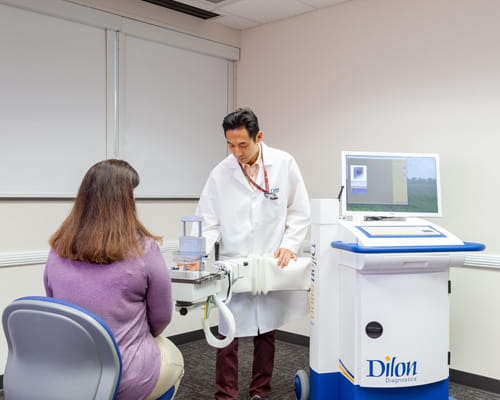
Many of the technologies that enable MBI were developed at Jefferson Lab for use in discovery scientific research. A suite of patents licensed by Dilon Technologies, Inc., was further developed into the first MBI system on the market. Deployed in dozens of clinics nationwide, these systems have saved women’s lives.
Now, Jefferson Lab researchers are working to improve MBI with even better image quality and more precise tumor location by adding a new device called a variable-angle slant hole collimator, or VASH collimator.
Current MBI systems use a traditional parallel hole collimator. This is a rectangular plate of dense metal with a grid of tiny parallel holes that filter the gamma rays emitted by the tracer. This helps the MBI camera to obtain a clear, well-defined image of any tumors.
The VASH collimator is constructed from a stack of tungsten sheets, each of which is just one quarter of a millimeter thick and features an identical array of square holes. Sliding the individual sheets by their edges slants the angle of the open filter channels in the stack. The result is systematic variation of the collimation angle during the imaging procedure.
“The challenge was to generate a synchronized motion. We had to develop a simple and precise control mechanism to move the 50 sheets at the same time. And we accomplished this with only two motors,” said Seungjoon Lee, a Jefferson Lab detector scientist and lead inventor for the VASH collimator.
Preliminary tests have demonstrated that the new device enables existing MBI systems to provide up to six times more contrast in images of tumors, while maintaining the same or better image quality and halving radiation dose to patients.
“You can get a whole range of angles of projections of the breast without moving the breast or moving the imager. You’re able to come in real close, you’re able to compress the breast, and you can get a one-to-one comparison to a 3D mammogram,” explained Drew Weisenberger, Jefferson Lab Radiation Detector and Imaging Group leader.
SmartBreast Corp. recently obtained the Dilon Technologies, Inc., product portfolio and is partnering with Jefferson Lab to complete development and clinical testing of the VASH collimator for use in MBI systems.
“Much of the proof-of-concept research has already been completed by Jefferson Lab, which will accelerate SmartBreast’s introduction of the technology into practical, life-saving products,” said SmartBreast CEO James Hugg. “This Jefferson Lab VASH technology will directly contribute to saving lives and avoiding the high cost of treating advanced cancer by detecting breast cancer earlier in dense breasts."
Through a cooperative research and development agreement (CRADA), Jefferson Lab and SmartBreast will work to clear the final hurdles to adding this fantastic new capability to MBI systems.
"One of the best ways to identify new research opportunities is by leveraging existing relationships. Nurturing this research and technology licensing relationship over years of collaboration with Dilon, even as the company transferred assets to SmartBreast, meant that our work could continue to change lives,” said Marla Schuchman, Jefferson Lab’s chief innovation officer.
This article was created in partnership with Jefferson Lab, learn more about their work.
Read more stories in the Basic2Breakthrough series.
