




Thermal Tracker Gathers Essential Bird and Bat Data
Computer algorithm combines with optics to help advance offshore wind development.
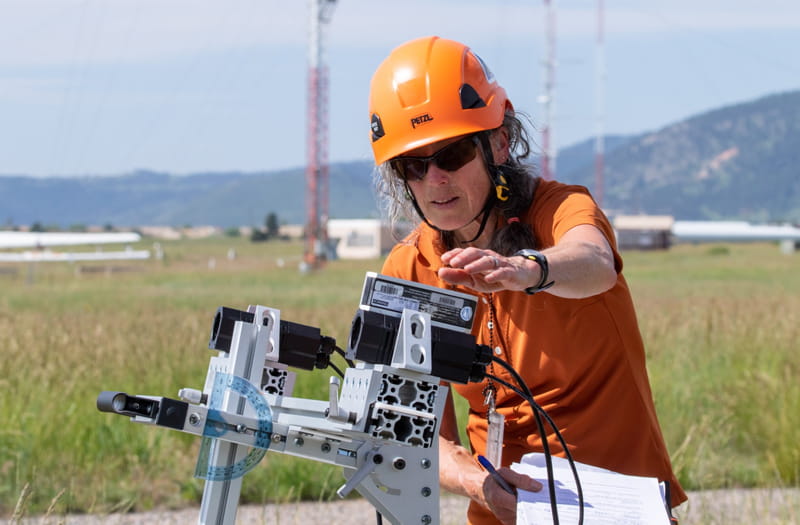
Wind energy will be a major component in the U.S. effort to reach the nation’s ambitious carbon reduction goals. The Department of Energy (DOE) expects that offshore wind turbines will generate 30 gigawatts of electricity—enough for 10 million homes—by 2030. The logistics of planning, constructing, and deploying wind turbine farms in a remote, harsh ocean environment are daunting enough. Adding to the complexity is the need to protect the well-being of numerous seabirds, including endangered species, as well as bats.
Before offshore wind developers can begin developing and siting wind farms, they must first have solid data to support environmental permitting to protect birds and bats from collisions with turbine blades and avoid habitat displacement.
Scientists have at least four decades of data about seabird behavior off the northern California coast, which is expected to be among the first areas selected for an offshore wind farm. But these data are limited to daytime observations and lack essential details.
To address this gap, Pacific Northwest National Laboratory (PNNL) engineers developed ThermalTracker-3D. The system, patented in December 2020, is a thermal stereo vision technology that can quantify the flight activity of birds and bats at remote locations. That makes it ideal for areas targeted for offshore wind farm development.
“ThermalTracker provides much more detailed information about individual animals—about how they're moving through space and when, including at night,” said Shari Matzner, the PNNL senior computer scientist who developed the system that was named an R&D 100 Award winner in 2021. “Using the ThermalTracker you can collect data on how birds and bats are using that offshore ocean habitat before turbines are put into place.”
The algorithm Matzner developed identifies birds and bats based on flight behaviors. The software, which incorporates thermal video, was designed to evaluate birds’ or bats’ flight paths and other data, such as how frequently their wings beat up and down, travel direction, flight height, wingspan, and body size. The stereo vision provides 3D position data, which helps determine if birds are flying at heights where turbines spin and if birds are avoiding existing turbines.
PNNL validated ThermalTracker’s detection and 3-D tracking capabilities on land in 2019. To validate its performance offshore, in 2021 PNNL researchers integrated the device with a Wind Sentinel buoy, a floating research platform that collects meteorological data, including very detailed wind speed and direction data for offshore wind farm development. They deployed the research craft, 25 miles off the northern California coast starting May 4 in an area identified as a potential wind farm location, and were able to assess bird activity in the area at the same time.
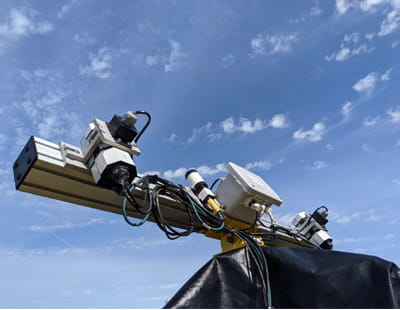
Sharon Kramer, a marine ecologist and principal in H.T. Harvey & Associates, a Los Gatos, California-based ecological consultant, has seen ThermalTracker’s performance at sea.
“There already was a pretty good compilation of data compiled from offshore observations by researchers starting in the 1970s,” said Kramer. “But that observation data does not say how high these birds are traveling. ThermalTracker fills that gap and many others, building a greater base of knowledge.”
Kramer noted that the 14-week ocean test differed significantly from the one on land.
“That’s an unstable platform at sea, obviously,” said Kramer. “Yet, ThermalTracker demonstrated the stabilization and ability to take spatial data and compensate for that motion.”
ThermalTracker’s commercialization potential is obvious to Marcus Chevitarese, principal of Sightir, a Santa Barbara, California-based company that specializes in digital imaging sales and consulting and that is working to commercialize the technology.
“ThermalTracker will allow regulatory agencies to make data-driven decisions that are based on more than human observation,” Chevitarese said. “I could also see ThermalTracker providing real time information for offshore wind farm operators, letting them make decisions to keep the power plant at maximum capacity and avoid harming the environment.”
Matzner concurs.
“ThermalTracker provides specific information that can be useful when deciding where to locate offshore wind turbines,” she said. “Our next step will be to build on the success of the offshore test and continue to deploy ThermalTracker to collect data that can be used for regulatory decision making.”
The technology was developed with funding provided by the DOE Wind Energy Technologies Office.
This article was created in partnership with Princeton Plasma Physics Laboratory, learn more about their work.
Read more stories in the Basic2Breakthrough series.
