




Accelerating Industry: Fermilab Makes an Impact with Compact Superconducting Radiofrequency Accelerators
Particle accelerator technologies are spurring new accelerators with applications in sterilizing medical devices, water and environmental cleanup, and materials research.
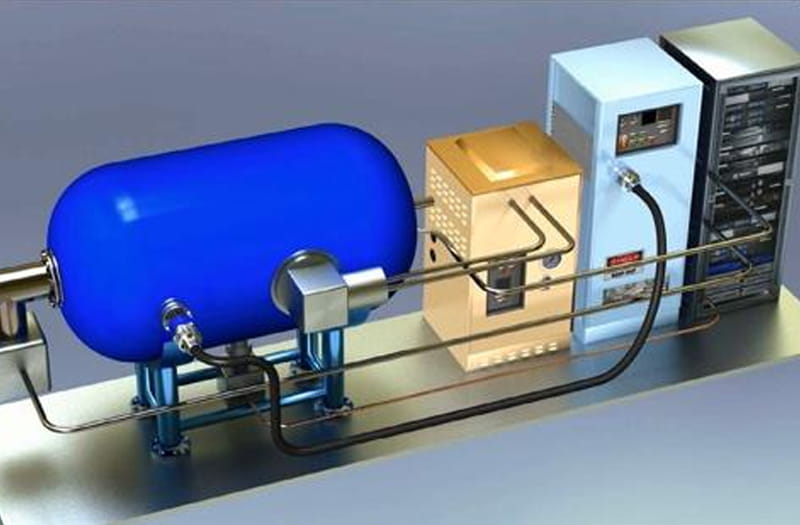
Particle accelerators are an important scientific tool, allowing researchers to study the tiniest particles that make up the universe and the forces that shape those particles. But particle accelerators are much more than scientific tools. Accelerators are widely used in industry, with more than 30,000 in operation worldwide. These accelerators support medicine, transistor manufacturing, material processing (tires and wires), the environment (waste treatment), and national security. Today’s particle accelerators work at room temperature, are not very energy efficient, and can be the size of a small building. This limits their use to specific applications.
Imagine if particle accelerators could make house calls. A team from the Department of Energy’s (DOE) Fermi National Accelerator Laboratory is working to make that possible: they are developing a powerful, compact, and mobile electron accelerator.
Fermilab, one of America's particle physics and accelerator laboratories, operates world-leading accelerator and detector facilities. A group within Fermilab, the Illinois Accelerator Research Center at Fermilab (IARC), facilitates partnerships between Fermilab and industry, universities, and other national labs to promote the industrial adoption of new accelerator technology. This leads to new products, capabilities, and businesses. As part of that mission, IARC’s technology development team is building compact, high-power superconducting-radiofrequency (SRF) electron accelerators that could make house calls.
SRF cavities enable accelerators to generate high-energy beams over short distances, making it possible to build compact linear accelerators — less than 2 meters long— that can accelerate electron beams to 99.9% of the speed of light, with average beam powers in the hundreds of kilowatts to one megawatt. Such powerful, compact SRF accelerators also have high power efficiencies and need simple radiation enclosures. This reduces their overall infrastructure costs.
Mauricio Suarez, deputy head of industry engagements at Fermilab, said, “What makes high-energy physics’ technology different is it has a very high bar for science demonstration. Once the technology has been demonstrated in big science projects, we know it works, and we know it can scale and solve problems. The challenges are on making it industry-friendly: efficient, compact, cost-effective, etc.”
A significant feature of the SRF accelerator is its transportability. This opens a completely new range of applications. For example, the U.S. military is collaborating with Fermilab to develop durable pavement for roads and runways by replacing traditional asphalt with a material that could be strengthened when irradiated with an electron beam from an accelerator.
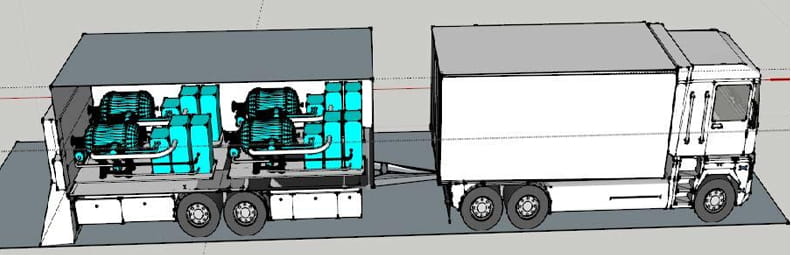
“The compact SRF accelerator gives us a tool to address an entirely new set of challenges that couldn’t be addressed before. For example, given the power and portability of the accelerator, it is possible to take the accelerator directly to the site where electron beams can be used to treat wastewater, harden pavement, or remediate soil. Once you start thinking about the applications our tool can enable, the impact can be wide-ranging,” said Charles Thangaraj, an accelerator physicist at IARC.
Accelerator-based electron beam technology also has significant applications in medical device sterilization. Fermilab is developing a prototype to demonstrate the generation of X-rays using a compact SRF accelerator. This approach shows promise as an alternative to current sterilization methods, which use gamma rays generated with radioactive isotopes such as cobalt-60. Fermilab is working with DOE’s National Nuclear Security Administration and DOE’s Office of Radiological Security to advance this application and reduce the global reliance on cobalt-60 and other highly radioactive materials for sterilization and other applications.
“We have been working on this technology for a couple of years and we are very excited on the progress,” said Suarez. “We are looking forward to continuing our collaboration with industry partners and matching the performance of compact accelerators to the needs of our partners. Our technology will help create products and services that will improve the health, wealth and security of U.S. citizens and people around the world.”
This article was created in partnership with Fermilab, learn more about their work.
Read more stories in the Basic2Breakthrough series.
