




Sense Like a Shark: Saltwater-Submersible Films
A nickelate thin film senses electric field changes analogous to the electroreception sensing organ in sharks, which detects the bioelectric fields of prey.
Official websites use .gov
A
.gov website belongs to an official government organization in the United States.
Secure .gov websites use HTTPS
A
lock (
) or https:// means you’ve safely connected to
the .gov website. Share sensitive information only on official,
secure websites.
A nickelate thin film senses electric field changes analogous to the electroreception sensing organ in sharks, which detects the bioelectric fields of prey.

Let’s talk! Scientists demonstrate coherent coupling between a quantum dot and a donor atom in silicon, vital for moving information inside quantum computers.
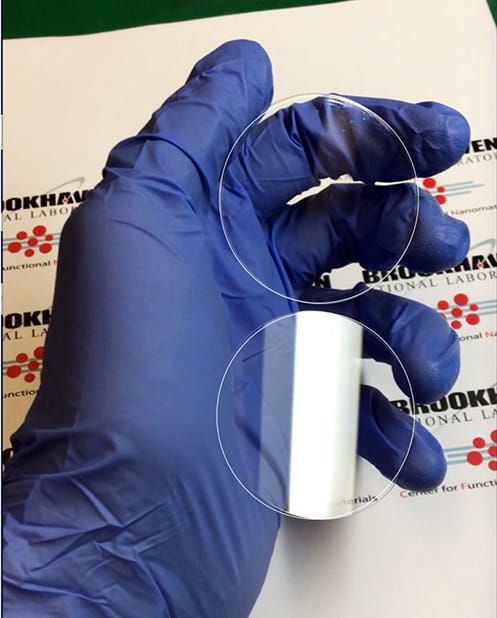
Creating nanotextured glass surfaces completely eliminates reflections of all colors of light, making the glass nearly invisible.

A new measurement using a beam of aluminum-26 prepared in a metastable state allows researchers to better understand the creation of the elements in our galaxy.

A mysterious mechanism that prevents instabilities may be similar to the process that maintains the Earth's magnetic field.

2-D velocity imaging helps fusion researchers understand the role of ion winds (aka flows) in the boundary of tokamak plasmas.

The size of a nucleus appears to influence the direction of certain particles emitted from collisions with spinning protons.

New class of solvents breaks down plant biomass into sugars for biofuels and bioproducts in a closed-loop biorefinery concept.

Study reveals surprising, bad chemical reactivity in battery components previously considered compatible.

Scientists use ion beams to write high-purity metal structures, enabling nanofabrication opportunities.

Water changes how cobalt-based molecule turns carbon dioxide into chemical feedstock.

Window material repeatedly switches from being see-through to blocking the heat and converting sunlight into electricity.
