




Measuring the Thickness of the Neutron Skin with Ultra-Relativistic Heavy Ion Collisions
Researchers determined the neutron skin of lead-208 from experimental data collected in lead-lead collisions at the CERN Large Hadron Collider.
Official websites use .gov
A
.gov website belongs to an official government organization in the United States.
Secure .gov websites use HTTPS
A
lock (
) or https:// means you’ve safely connected to
the .gov website. Share sensitive information only on official,
secure websites.
Researchers determined the neutron skin of lead-208 from experimental data collected in lead-lead collisions at the CERN Large Hadron Collider.

The Project 8 and He6-CRES collaborations use a new technique to set an upper limit on neutrino mass and prepare to test the nature of the weak force.

Scientists engineered a model bacterium's genetic code to make it virus-resistant and unable to exchange genetic material or grow without special media.

Scientists translate predictions of hydrodynamics into experimentally observable particle patterns.
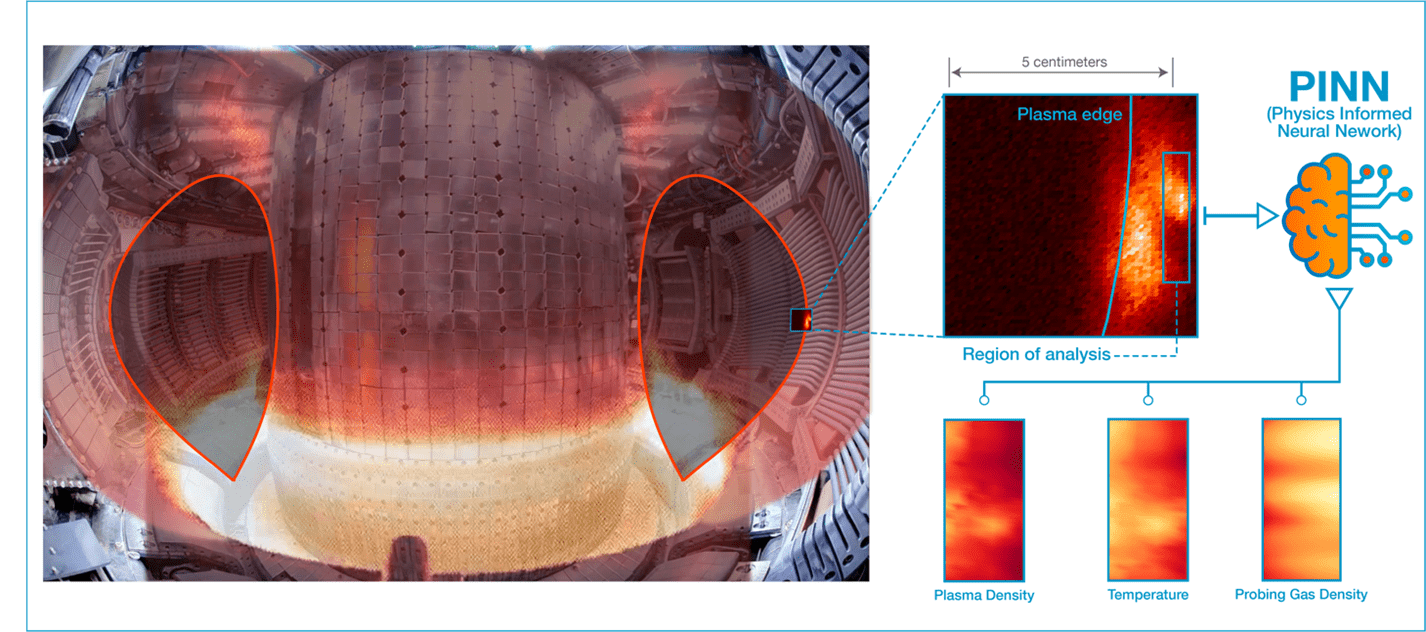
Neural networks guided by physics are creating new ways to observe the complexities of plasmas.

Quantum simulations reveal the presence of entanglement among the quarks produced in high energy collisions.

Scientists investigate neutrinoless double beta decay through neutrino mass and the nuclear structure of germanium-76.

Ligand design and electrochemical studies pave a new path toward stable high-valent mid-actinide complexes.

A newly discovered excited state in radioactive sodium-32 has an unusually long lifetime, and its shape dynamics could be the cause.

Measurements of the nuclear structure of cesium-136 open a new channel for measurements of astrophysical neutrinos and searches for dark matter.

Machine learning and artificial intelligence accelerate nanomaterials investigations.

A new microscopy technique measures atomic-level distortions, twist angles, and interlayer spacing in graphene.
