




Forever Young Catalyst Reduces Diesel Emissions
Atom probe tomography reveals key explanations for stable performance over a cutting-edge diesel-exhaust catalyst’s lifetime.
Official websites use .gov
A
.gov website belongs to an official government organization in the United States.
Secure .gov websites use HTTPS
A
lock (
) or https:// means you’ve safely connected to
the .gov website. Share sensitive information only on official,
secure websites.
Atom probe tomography reveals key explanations for stable performance over a cutting-edge diesel-exhaust catalyst’s lifetime.

A nickelate thin film senses electric field changes analogous to the electroreception sensing organ in sharks, which detects the bioelectric fields of prey.

Let’s talk! Scientists demonstrate coherent coupling between a quantum dot and a donor atom in silicon, vital for moving information inside quantum computers.
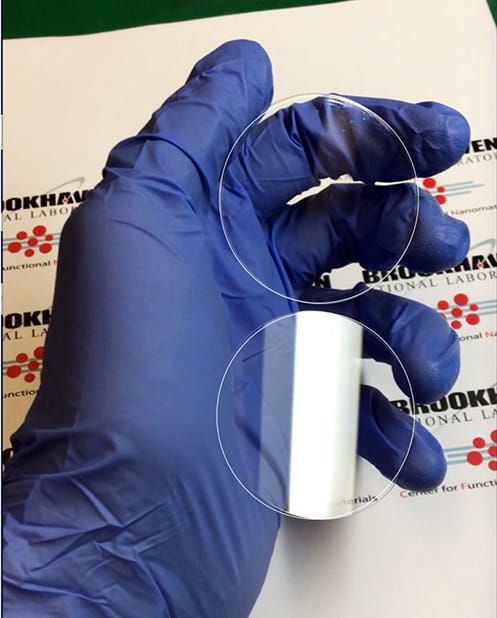
Creating nanotextured glass surfaces completely eliminates reflections of all colors of light, making the glass nearly invisible.

Study reveals surprising, bad chemical reactivity in battery components previously considered compatible.

Scientists use ion beams to write high-purity metal structures, enabling nanofabrication opportunities.

Water changes how cobalt-based molecule turns carbon dioxide into chemical feedstock.

Window material repeatedly switches from being see-through to blocking the heat and converting sunlight into electricity.

Scientists used an intense light to unveil hidden rivers that transport electricity with no loss.

Neutron probes and theory reveal how electrons cooperate at lower temperatures.

New spectroscopic technique measures heat in itty-bitty volumes that could reveal insights for electronics and energy technology.

Scientists use new X-ray technique to see how water moves at the molecular level.
