




STAR Sees a Magnetic Imprint on Deconfined Nuclear Matter
Data from heavy ion collisions give new insight into the electromagnetic properties of quark-gluon plasma “deconfined” from protons and neutrons.
Official websites use .gov
A
.gov website belongs to an official government organization in the United States.
Secure .gov websites use HTTPS
A
lock (
) or https:// means you’ve safely connected to
the .gov website. Share sensitive information only on official,
secure websites.
Data from heavy ion collisions give new insight into the electromagnetic properties of quark-gluon plasma “deconfined” from protons and neutrons.

Pushing boundaries with radioactive molecules for future studies of nuclear structure and fundamental symmetry.

Researchers dramatically improve the limits for several exotic dark matter models.

Scientists study a key reaction in X-ray bursts, shedding light on the reaction mechanisms behind thermonuclear flare-ups during these events.

Researchers find a new contribution to the proton Sivers function that describes the internal rotation of the proton perpendicular to its velocity.

The discovery of new isotopes demonstrates the user facility’s discovery potential.

The observation of a rare potassium-40 decay aids in estimating neutrinoless double-beta decay half-life and dating geological features.

Theorists propose nucleon energy-energy correlator as a probe to the gluon saturation phenomena at the future electron-ion collider.

Quantum entanglement changes in atomic nuclei in ways that differ from other systems.
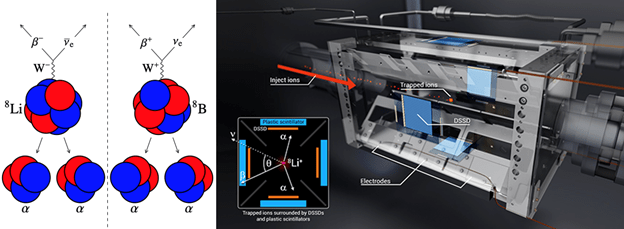
Scientists develop a new method to characterize the properties of one of the four fundamental forces of nature.

Scientists test a novel design for superconducting switches in magnetic fields.

Scientists in nuclear physics, astrophysics, energy, national security, and medicine use a source of recommended nuclear data to advance their research.
