



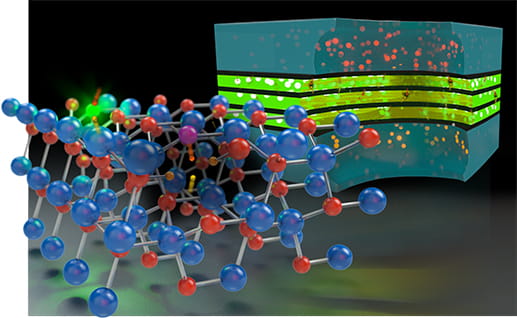
LED Lighting May Now Shine Brighter
Scientists apprehended the atomic-scale, microscopic mechanism that limits light emission in LED lighting.
Official websites use .gov
A
.gov website belongs to an official government organization in the United States.
Secure .gov websites use HTTPS
A
lock (
) or https:// means you’ve safely connected to
the .gov website. Share sensitive information only on official,
secure websites.
Scientists apprehended the atomic-scale, microscopic mechanism that limits light emission in LED lighting.

Computer-designed molecular complex can be used in halogen-free electrolytes for batteries with superior performance.

New findings will help extend the lifetime of catalysts used to process bio-oils in liquid systems.

The orientation-dependent thermal properties of black phosphorous could be used to keep microchips cool and improve their efficiency.

Junctions between conductive graphene and insulating nanotubes could lead to faster electronics and computers.

Understanding how gold alloy cracks provides insight for material failures for nuclear power.

Liquid metal transforms solid alloy into pore-filled structure that could be used in future batteries.

Inexpensive method allows synthesis of a tiny solar cell that pumps out fuel.

New tabletop laser achieves sought-after energies needed for advanced characterization with unprecedented precision and range.

Templates allow for materials with deliberate sizes and shapes for solar cells and electricity generation from waste heat.

Theoretical modeling of energy loss in solar cells may lead to more efficient materials to convert sunlight to electricity.

Atomic-scale simulations predict how to use nanoparticles to increase hydrogen production.
