




Soft and Small Imaging Breakthrough
Researchers develop breakthrough technique for non-invasive electron microscopy for soft materials
Official websites use .gov
A
.gov website belongs to an official government organization in the United States.
Secure .gov websites use HTTPS
A
lock (
) or https:// means you’ve safely connected to
the .gov website. Share sensitive information only on official,
secure websites.
Researchers develop breakthrough technique for non-invasive electron microscopy for soft materials

Superacid treatment of semiconductors could lead to atomically perfect transparent displays and energy-efficient computer chips.

Molecular Foundry-pioneered instrument produces detailed views of lightweight atoms.

First-of-their-kind images could aid in use of DNA to build tiny, lightweight devices.

Researchers trapped and detected ensembles of electrons, an important step in isolating single electrons for use in a new generation of low-power supercomputing.

International team shows that modified graphene is 105 times more sensitive at detecting ammonia.

This development could lead to new materials for ultra-small transistors, diodes, and more

Disentanglement reveals exotic magnetic properties in a ytterbium-based compound.

Computer-designed molecular complex can be used in halogen-free electrolytes for batteries with superior performance.
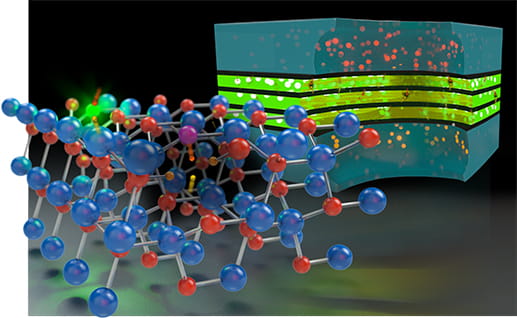
Scientists apprehended the atomic-scale, microscopic mechanism that limits light emission in LED lighting.

New findings will help extend the lifetime of catalysts used to process bio-oils in liquid systems.

The orientation-dependent thermal properties of black phosphorous could be used to keep microchips cool and improve their efficiency.
