




Nanocrystals Help Magnesium Batteries Go On-the-Move
Magnesium metal anodes display improved cycling and temperature performance capabilities for rechargeable magnesium batteries.
Official websites use .gov
A
.gov website belongs to an official government organization in the United States.
Secure .gov websites use HTTPS
A
lock (
) or https:// means you’ve safely connected to
the .gov website. Share sensitive information only on official,
secure websites.
Magnesium metal anodes display improved cycling and temperature performance capabilities for rechargeable magnesium batteries.

Discovery of new boron-containing phase opens the door for resilient flexible electronics.

The two most abundant elements in the universe, hydrogen and helium, were previously thought to be impossible to measure by X-ray photoelectron spectroscopy.
Read more about X-ray Spectroscopy of Hydrogen and Helium
Scientists can now measure 3-D structures of tiny particles with properties that hold promise for advanced sensors and diagnostics.
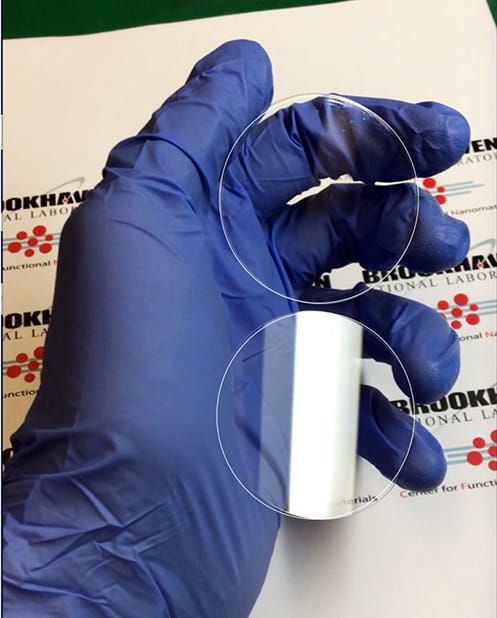
Creating nanotextured glass surfaces completely eliminates reflections of all colors of light, making the glass nearly invisible.

Scientists demonstrated that powerful acids heal certain structural defects in synthetic films.

Novel engineered polymers assemble buckyballs into columns using a conventional coating process.

Tiny cages can trap and release inert argon gas atoms, allowing their further study and providing a new way to capture rare gases.

Engineered stacked perovskite layers harvest light or create light via layer edges.

Real-time imaging shows how hydrogen causes oxygen to leave a buried surface, transforming an oxide into a metal.

Scientists reveal structural, chemical changes as nickel-cobalt particles donate electrons, vital for making better batteries, fuel cells.

Scientists combine biology, nanotechnology into composites that light up upon chemical stimulation.
