



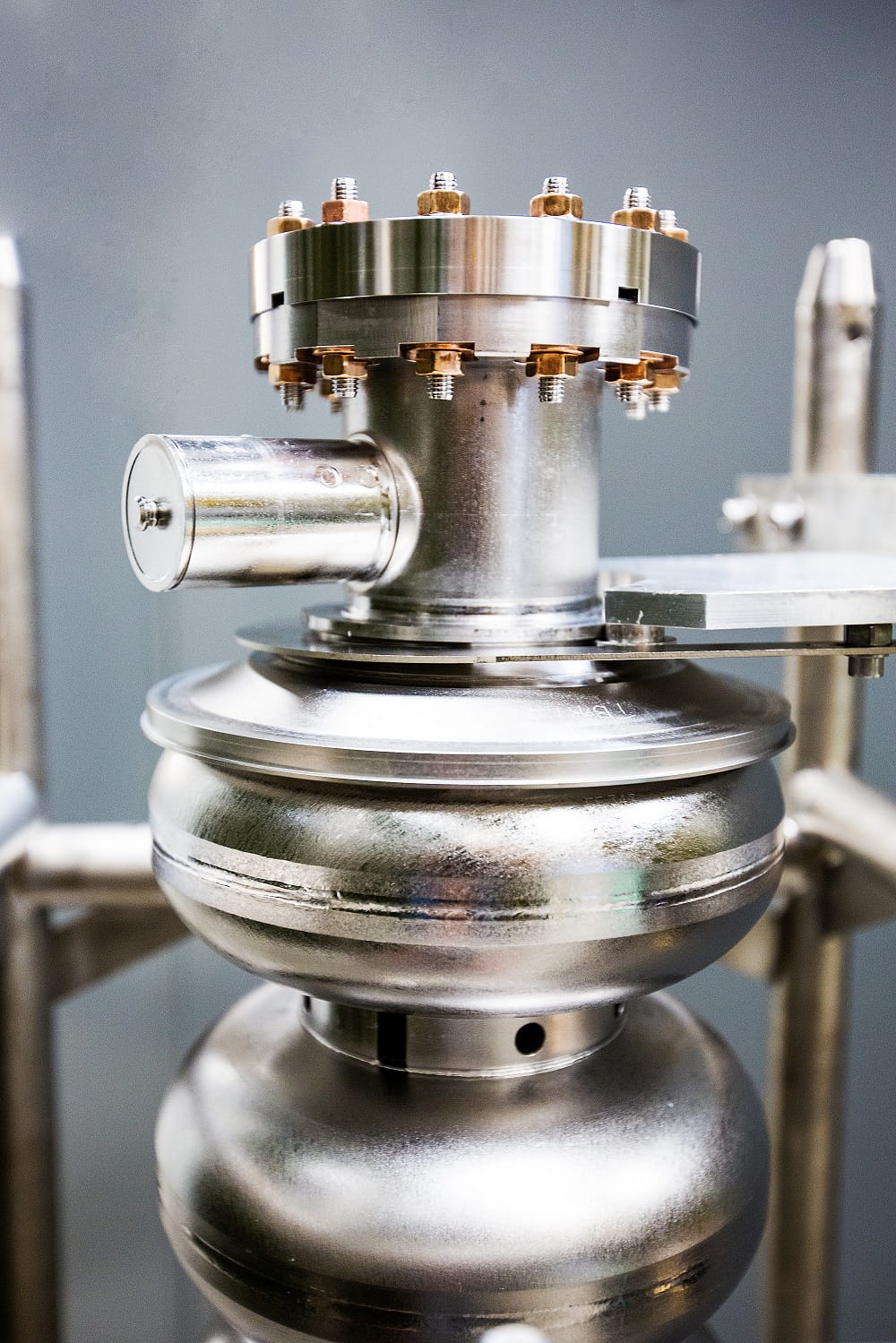
Smoother Surfaces Make for Better Particle Accelerators
An enhanced topographic analysis toolkit for forecasting and improving particle accelerator performance is helping scientists build better accelerators.
Official websites use .gov
A
.gov website belongs to an official government organization in the United States.
Secure .gov websites use HTTPS
A
lock (
) or https:// means you’ve safely connected to
the .gov website. Share sensitive information only on official,
secure websites.
An enhanced topographic analysis toolkit for forecasting and improving particle accelerator performance is helping scientists build better accelerators.

Electron transfer between atomically thin materials triggers the ultrafast release of heat.

Scientists discover that superconductivity in copper-based materials is linked with fluctuations of ordered electric charge and mobility of vortex matter.

Machine learning methods support human operators in diagnosing and fixing failing subsystems in an accelerator-driven X-ray laser.

Ultrafast X-ray studies reveal the existence of Superionic Ice XIX, which could explain the unusual magnetic fields of icy giant planets.

Scientists illuminate the quantum dynamics of electrons in highly excited molecules.

Neural networks determine the amplitude and phase of X-ray pulses, enabling new, high-resolution quantum studies.

Scientists capture the short-lived hydroxyl-hydronium pair and the induced dynamic response in ionized liquid water in unprecedented detail.

Discovery of a short-lived state could lead to faster and more energy-efficient computing devices.

Ultrafast electrons shed light on the web of hydrogen bonds that gives water its strange properties, vital for many chemical and biological processes.

A newly designed X-ray oscillator may enable atomic level precision with intense X-ray pulses.

Scientists use a machine learning algorithm to reduce tuning time of a dozen instruments at once.
