




Re-Energizing the Lithium-Ion Battery
Scientists seek to improve the battery by investigating the detailed interactions lithium ions experience with liquid battery electrolytes.
Official websites use .gov
A
.gov website belongs to an official government organization in the United States.
Secure .gov websites use HTTPS
A
lock (
) or https:// means you’ve safely connected to
the .gov website. Share sensitive information only on official,
secure websites.
Scientists seek to improve the battery by investigating the detailed interactions lithium ions experience with liquid battery electrolytes.

Research uncovers the errors that prevent modeled precipitation variations from matching real-world results.

Scientists identified defects responsible for detrimental blinking that limits nanoparticle use in LEDs, solar cells, and lasers.

New approach could benefit applications as diverse as propeller and printers.

Microporous polymer separator prevents specific molecules from crossing battery and causing degradation and shorter lifetimes.

Novel self-assembly can tune the electronic properties of graphene, possibly opening doors for tiny, powerful electronic devices.

Materials based on clusters of atoms called “super-ions” may revolutionize the whole solar cell industry.

Computer-designed molecular complex can be used in halogen-free electrolytes for batteries with superior performance.
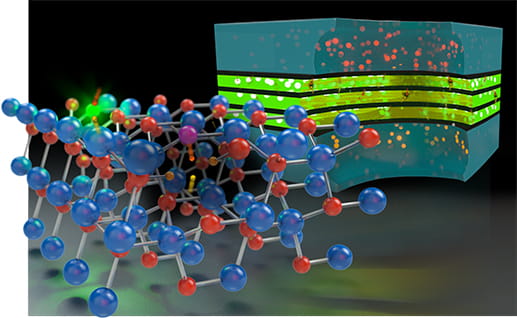
Scientists apprehended the atomic-scale, microscopic mechanism that limits light emission in LED lighting.

Recycling waste from biofuel production could lower cost for future biorefineries.

New findings will help extend the lifetime of catalysts used to process bio-oils in liquid systems.

Theoretical modeling of energy loss in solar cells may lead to more efficient materials to convert sunlight to electricity.
