




Novel Theory-Based Evaluation Gives a Clearer Picture of Fusion in the Sun
Theoretical calculations and experimental data combine to reduce uncertainty in a key reaction rate in modelling high-energy solar neutrinos.
Official websites use .gov
A
.gov website belongs to an official government organization in the United States.
Secure .gov websites use HTTPS
A
lock (
) or https:// means you’ve safely connected to
the .gov website. Share sensitive information only on official,
secure websites.
Theoretical calculations and experimental data combine to reduce uncertainty in a key reaction rate in modelling high-energy solar neutrinos.
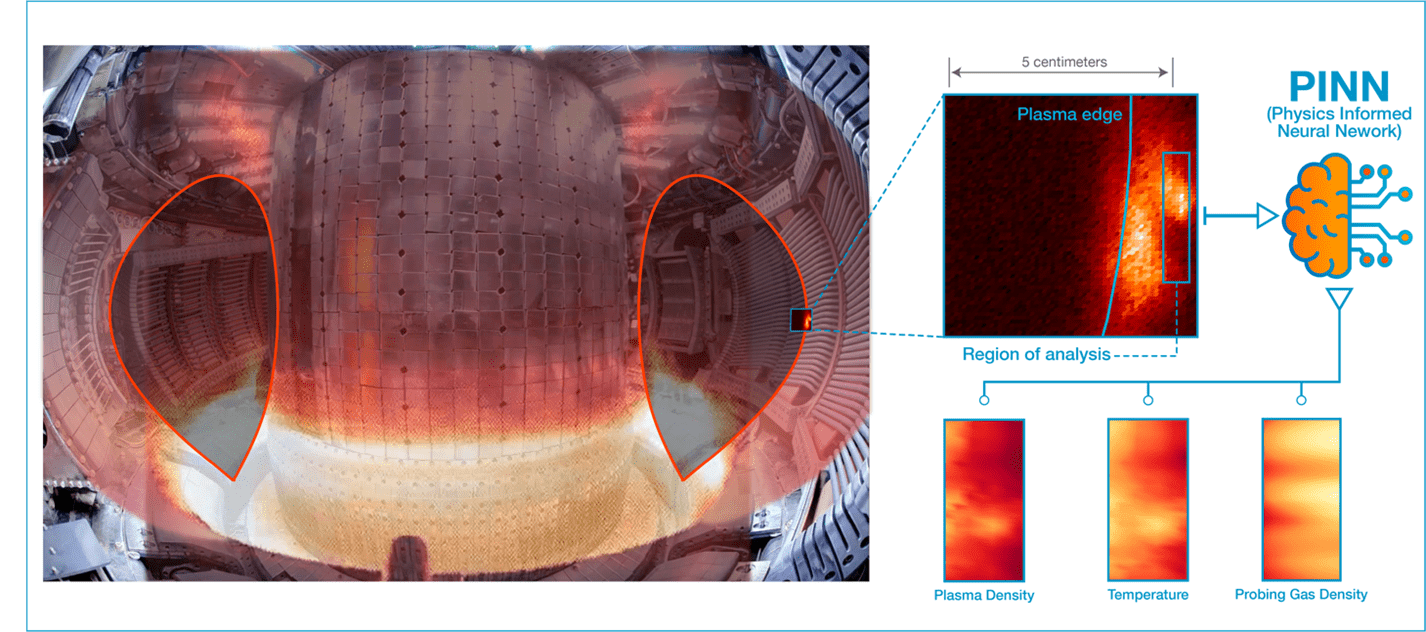
Neural networks guided by physics are creating new ways to observe the complexities of plasmas.

A measurement tracking ‘direct’ photons from polarized proton collisions points to positive gluon polarization.

Machine learning and artificial intelligence accelerate nanomaterials investigations.

A new microscopy technique measures atomic-level distortions, twist angles, and interlayer spacing in graphene.

Researchers examine the structure of the low-energy nuclear states of carbon-12 using nuclear lattice effective field theory.

Solving atomic structure and binding for improved antiviral drugs.

Scientists illuminate the quantum dynamics of electrons in highly excited molecules.

Scientists use a common engineering approach to enhance the superconductivity and induce ferroelectricity in the quantum material strontium titanate.

MemHC improves the efficiency of complex supercomputer physics calculations by optimizing memory management.

New results will help physicists interpret experimental data from particle collisions and better understand the interactions of quarks and gluons.

For the first time, scientists observe a new and rare decay mode where oxygen-13 breaks into three helium nuclei and a proton following beta decay.
