




Modeling Choices and the Effects of Water Runoff on Plant Productivity
Understanding differences in modeling soil water will help scientists simulate how this moisture affects the climate.
Official websites use .gov
A
.gov website belongs to an official government organization in the United States.
Secure .gov websites use HTTPS
A
lock (
) or https:// means you’ve safely connected to
the .gov website. Share sensitive information only on official,
secure websites.
Understanding differences in modeling soil water will help scientists simulate how this moisture affects the climate.

First atomically thin, halide perovskite sheets could be an alternative to graphene for future electronics.

Novel self-assembly can tune the electronic properties of graphene, possibly opening doors for tiny, powerful electronic devices.

Implanted helium ions “tuned” complex behaviors—enabling design of new materials for efficient electricity storage and testing theories.

Meticulously designed oxide thin films exhibit well-defined ON/OFF states that could be used in small, energy-efficient electronics.

Superacid treatment of semiconductors could lead to atomically perfect transparent displays and energy-efficient computer chips.

First-of-their-kind images could aid in use of DNA to build tiny, lightweight devices.

International team shows that modified graphene is 105 times more sensitive at detecting ammonia.

This development could lead to new materials for ultra-small transistors, diodes, and more

Computer-designed molecular complex can be used in halogen-free electrolytes for batteries with superior performance.
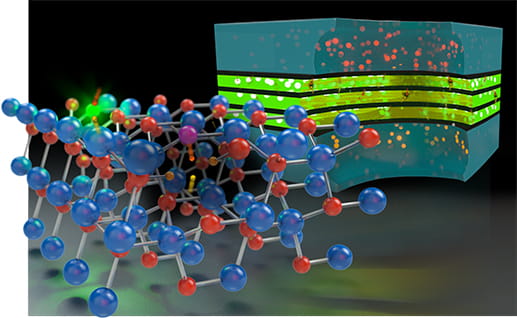
Scientists apprehended the atomic-scale, microscopic mechanism that limits light emission in LED lighting.

Understanding how iron minerals accelerate collaborative metabolism will expand insights into the global carbon cycle.
