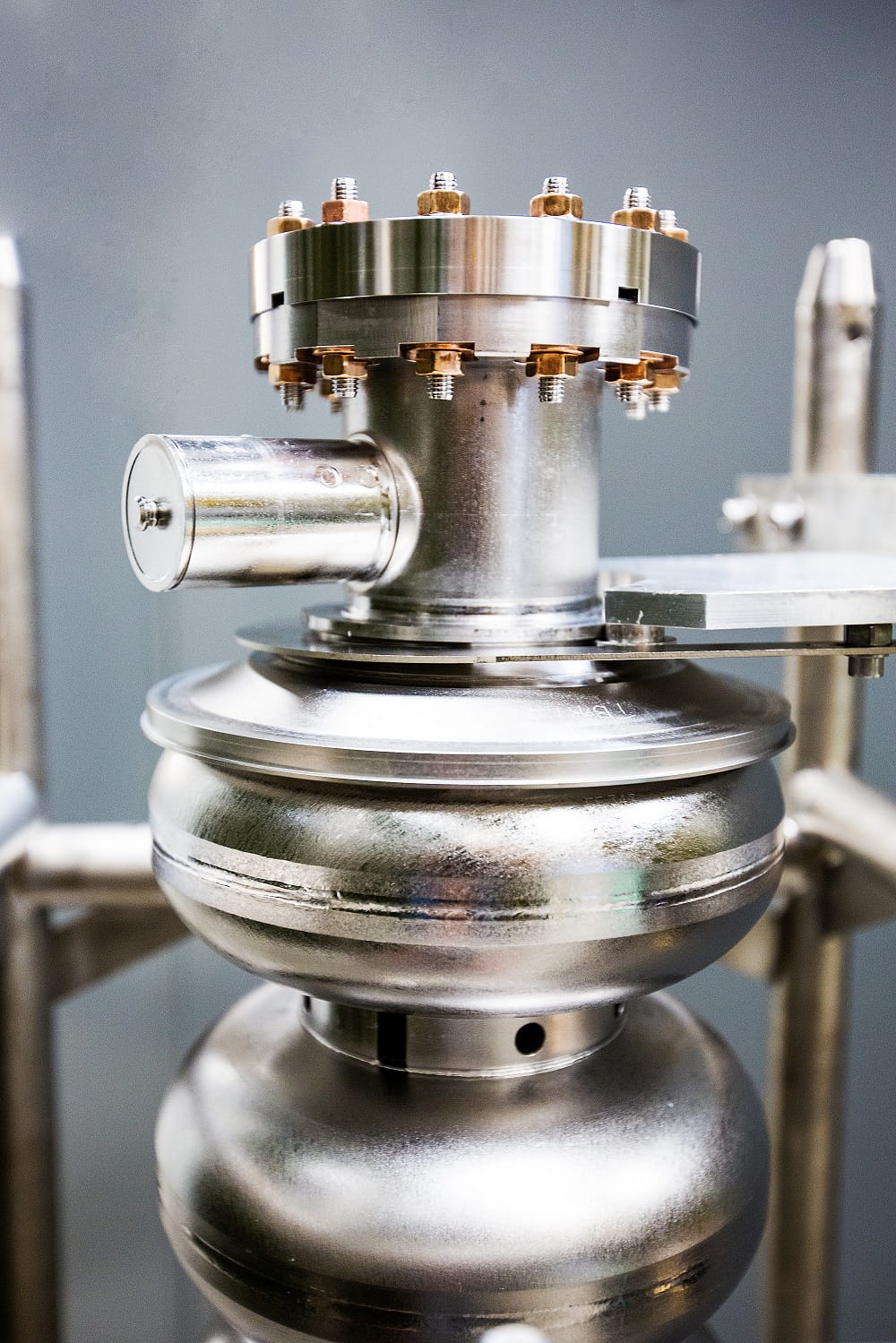
Ice-Cold Plasma Electron Beams Prepare to Power Future Hard X-ray Laser Beams
Scientists chart a path to sub-femtosecond hard X-ray Free-Electron-Laser pulses powered by compact plasma-based accelerators.
Recent advances enable simulations near a possible critical endpoint of the transition between the quark gluon plasma and a hadron liquid.
New nuclear physics measurements shed light on the synthesis of heavy elements in stars.
The Facility for Rare Isotope Beams opens a new research avenue and observes three new rare isotopes.
Nuclear physicists shatter a nearly 30-year-old record for the measurement of parallel spin within an electron beam.
Scientists have detected nuclear decay by observing the recoil of a dust-sized particle when a single nucleus within it decays.
High-surface area silicon improves light-driven reactions of carbon dioxide.
Scientists learn how to manipulate quantum properties in graphene to create resistance-free, electricity channels for loss-free future electronics.
Synchrotron X-ray spectroscopy allows atom-level examination of iron and terbium atoms.
Two types of superconductivity compete at the edge between a topological semimetal and a conventional metal, causing the electrons to switch behavior erratically.
Spatial transcriptomics, combined with single-cell expression profiling, reveals new information on plant/arbuscular mycorrhizal interactions.
Free-flowing metal powders offer improvements for additive manufacturing, isotope production target fabrication, and more.